Topic · Basics & terms · 2026-06-17
What is a UFO — and what is a UAP?
Almost everyone says “UFO” — and often already means an answer by it. Yet the word is above all an admission.
Does “UFO” describe a riddle in the sky — or just the state of our knowledge?
The terms are well documented; what is contested is never the word, but the interpretation read into it.
This trail separates what three letters actually claim from what we read into them. By the end you can name what stays open: the origin.

KI-generiert (Seedream 4.5, From Beyond Space)
Context
What “UFO” literally means
UFO = Unidentified Flying Object. A flying object nobody has (yet) identified — nothing more.
Coined by the US Air Force in the early 1950s (Project Blue Book) as a sober replacement for “flying saucer.” The term was meant to take sensation out, not add it.
The three words individually
Unidentified (not assigned) · Flying (in the sky) · Object (something tangible — even that is an assumption).
The irony of the term
“UFO” was invented to sound more serious than “flying saucer” — today it sounds sensational itself. Terms age.
Graphic illustration · KI-generiert (GPT-Image-2, From Beyond Space), faktengeprüft
Turning point
confirmedWhere does “UAP” come from — and why the switch?
UAP replaces UFO in official texts for three reasons: less stigma, often no solid “object,” and a focus on sensor data.
Navy reporting procedures from ~2019, ODNI report 2021: “Unidentified Aerial Phenomena.” In 2022 AARO broadens it to “Unidentified Anomalous Phenomena” — to also cover water and space (transmedium).
- 1952
Project Blue Book
term UFO coined
- 2019
US Navy
pilot reporting procedure
- 2021
ODNI report
UAP = Aerial Phenomena
- 2022
AARO
Anomalous: water & space too
Aerial becomes Anomalous
First “Aerial” (air), then “Anomalous” — so phenomena under water or in space are covered too (transmedium).
Why not just UFO?
The stigma kept pilots from reporting. A neutral term lowers the bar — that is the actual purpose.
Was the stigma deliberate?
Partly yes — and it is on the record. In 1953 a CIA advisory panel explicitly recommended a “debunking” program to dampen public interest.
What is documented are individual, dated episodes of deliberate dampening. NOT documented is a continuous, coordinated decades-long campaign — that is interpretation, not record. Sources: Robertson Panel/Durant Report (1953), Low memo (1966).
CIA panel, Durant Report. Recommended a “debunking” program via media and the monitoring of civilian UFO groups. Aim: reduce public interest.
Internal note (Condon study): the study should appear “objective” while run by “non-believers.” Result: resignation, firings, NICAP withdrawal.
Do such campaigns still exist today?
Whistleblower David Grusch claims exactly that — but it is not publicly proven.
Learning anchor: testimony under oath makes a claim worth checking — not proven. (As of June 2026 still open and contested.)
Grusch testified under oath before Congress in 2023. The testimony as an event is real and documented.
An ongoing disinformation campaign (true + false info mixed) and crash-retrieval programs. Pentagon/AARO dispute verified evidence.
Thinking trap
“Unidentified” does not mean “extraterrestrial”
The “U” is a statement about our knowledge, not about origin. Unidentified = not yet assigned.
Most reported phenomena are later explained as balloons, drones, Starlink trains, or sensor artifacts. “Not explained” is an interim state, not a verdict.
Most cases are later explained as something ordinary.

A freshly launched Starlink train in the night sky — a pattern regularly reported as a supposed UFO formation and later explained as something ordinary.
KI-generiert (Seedream 4.5, From Beyond Space)
The trap in one sentence
“not explained” ≠ “inexplicable.” One is a processing state, the other a final verdict.
What “identified” means in practice
A case counts as resolved when an ordinary explanation fits the data better — not when someone merely claims it was nothing.
Thinking trap
“Anomalous” does not mean “physically impossible”
Anomalous means: deviates from the expected. That can be the sensor, the angle, or the state of knowledge — not necessarily exotic physics.
An “impossible” maneuver on a video can be a parallax or camera effect. An anomaly is a reason to check, not a finished conclusion.
Often it is the sensor, the angle, or the state of knowledge.
Context
Object, phenomenon, interpretation
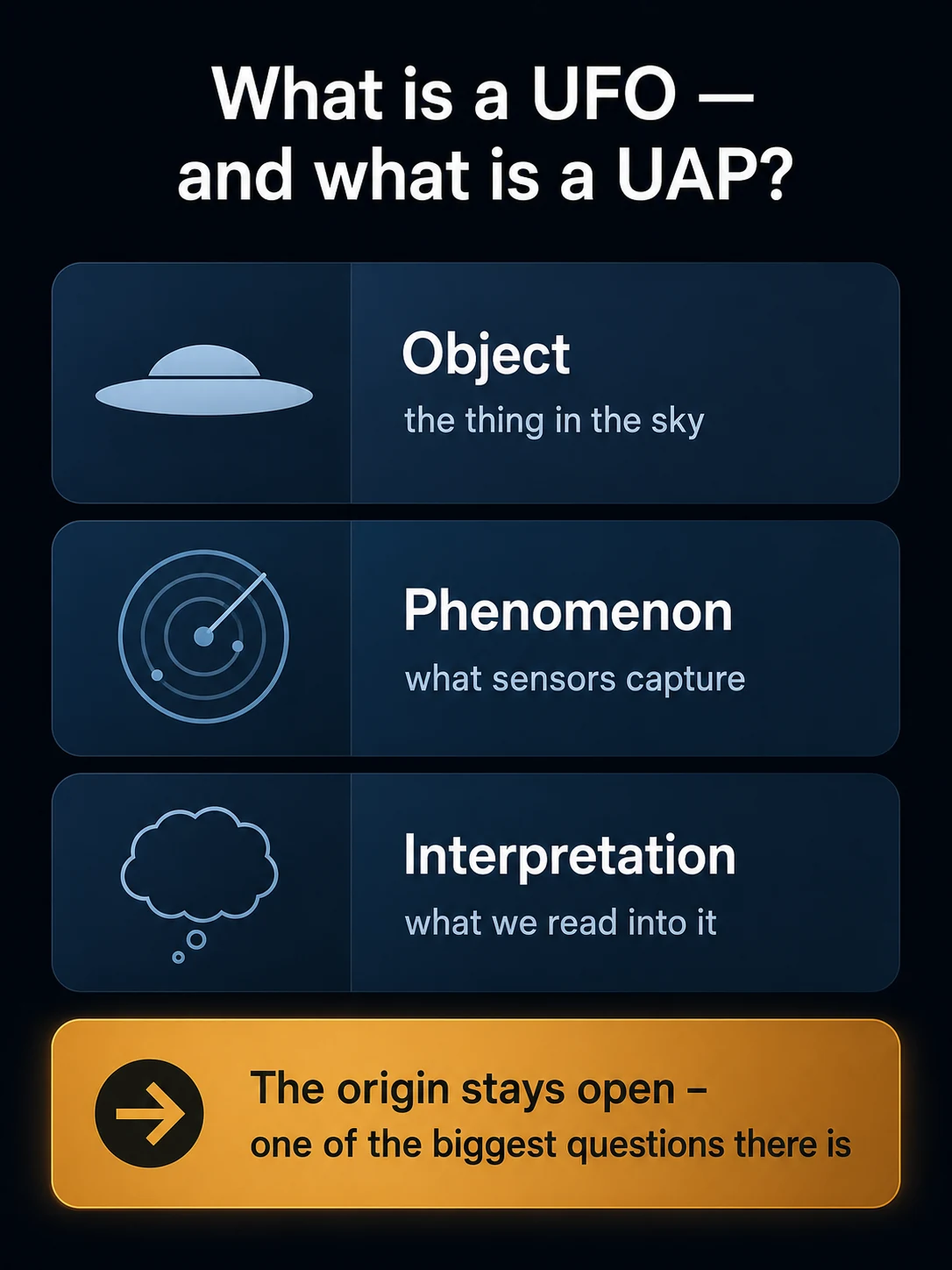
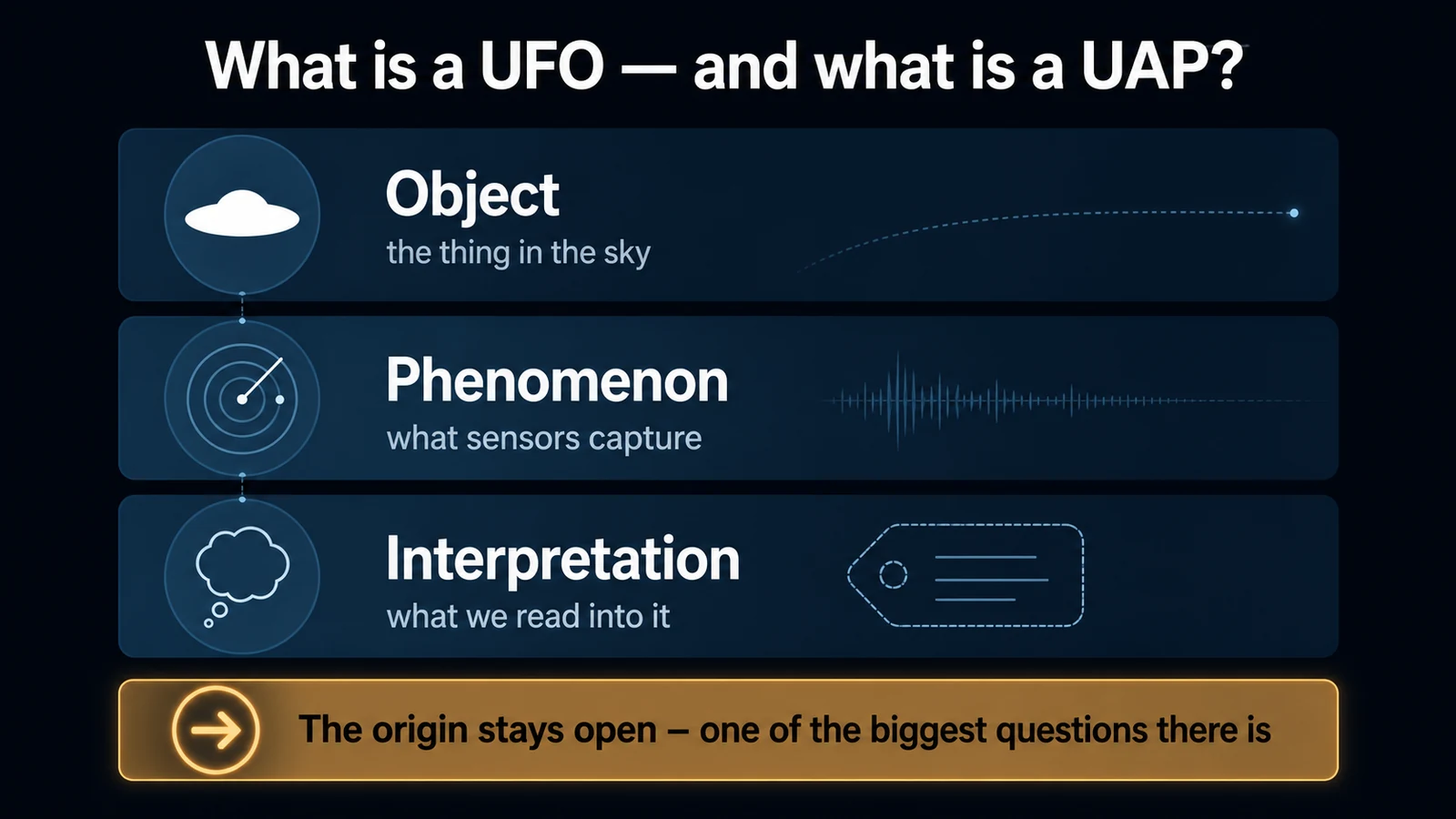
Three levels that constantly merge: what is in the sky (object), what is registered (phenomenon), what it means (interpretation).
Most misunderstandings arise when a phenomenon (a point of light) is immediately read as an interpretation (“extraterrestrial”). Separate the levels and you stay precise.
An example
A bright dot on radar = phenomenon. The thing itself = object (unknown). “A drone” = interpretation. Three statements, three degrees of certainty.
Open question
What you can now distinguish
You can now say what “UFO” really claims — and what stays open: the origin.
This is exactly where the next topics begin: must a UFO be extraterrestrial? How do you assess a sighting? The terms are settled — the questions begin.

KI-generiert (Seedream 4.5, From Beyond Space)