Topic · Research & institutions · 2026-06-26
UFOs — only a US topic? Global UAP research
Almost all headlines come from Washington. That creates the impression that only America takes the topic seriously. In fact the phenomenon is officially investigated in dozens of countries — on almost every continent.
Is UAP research an American special case — or a worldwide, state-handled topic?
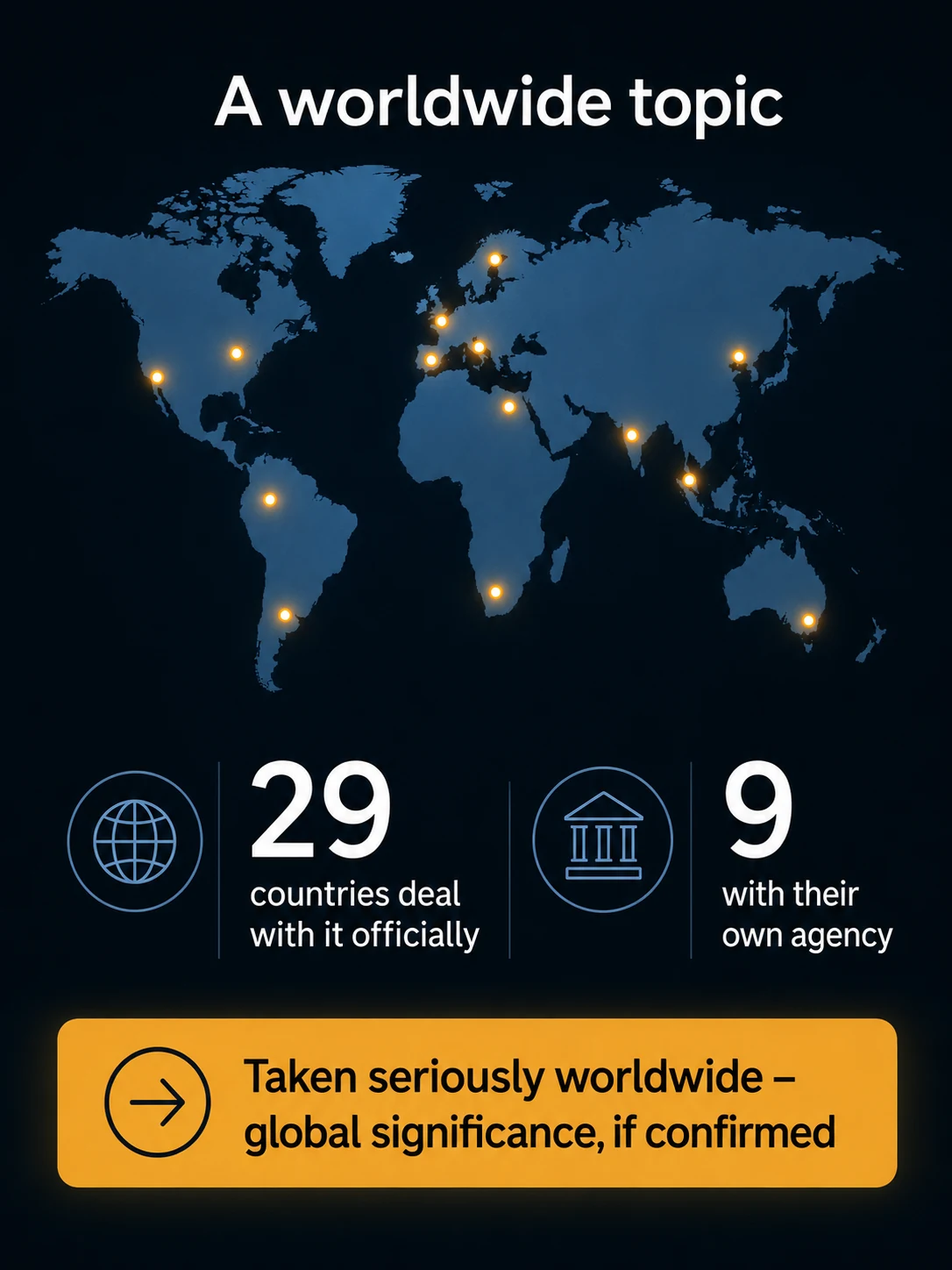
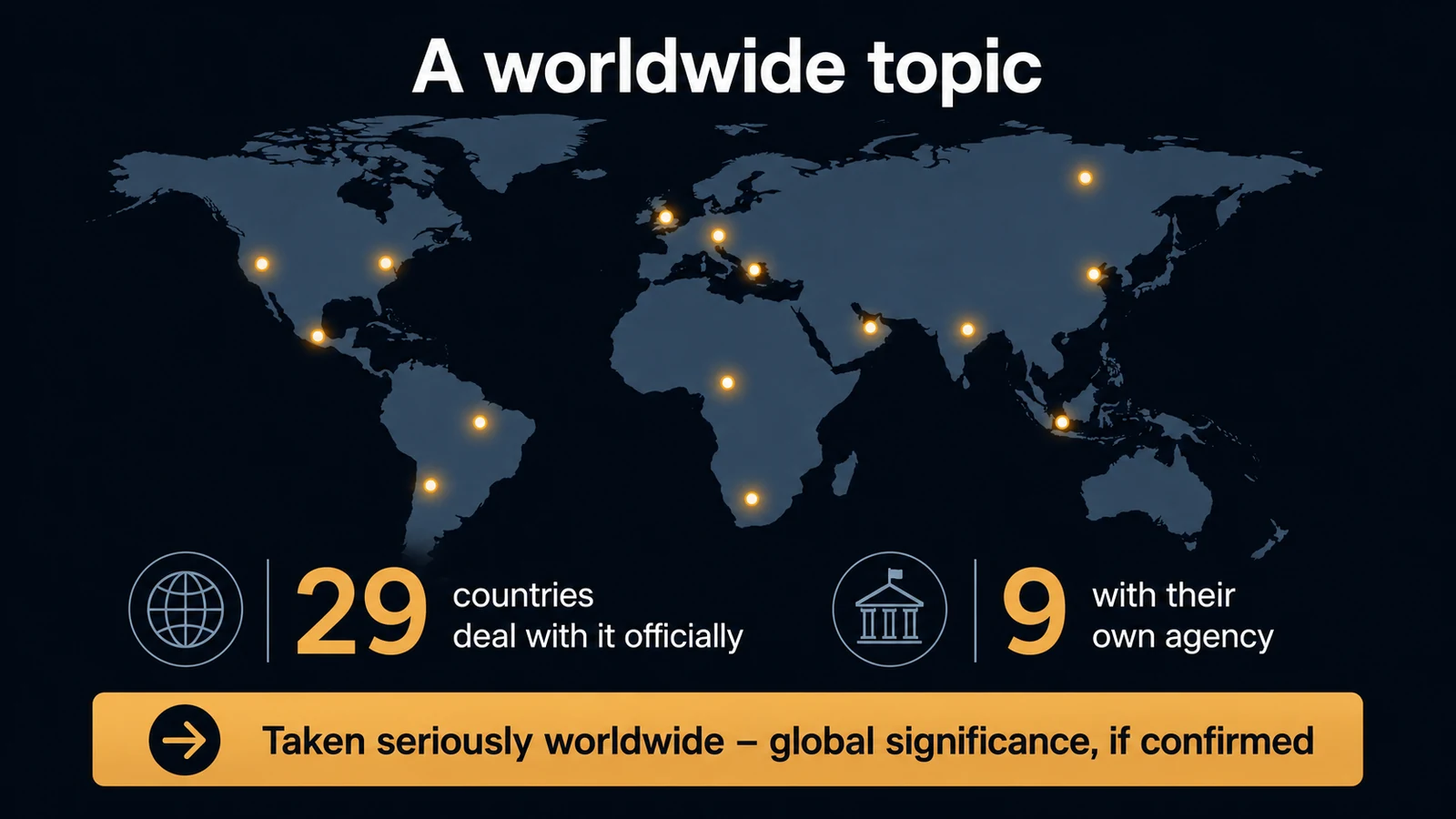
At least 29 countries have officially dealt with the phenomenon, nine with purpose-built agencies. What matters is not WHETHER research happens worldwide, but how openly — from published case files to secret programs revealed only late.
This trail shows how far state UAP research actually reaches. By the end you will see that “only the US” is a distortion — and why a handful of countries still stand out.

KI-generiert (Seedream 4.5, From Beyond Space)
Claim
confirmedAt least 29 countries — nine with their own agency
At least 29 states have officially dealt with UFOs; nine created purpose-built bodies for it. This is no US special case.
The nine countries with their own agency: Argentina, Chile, China, France, Canada, Peru, Russia, Uruguay and the US — plus secret military programs in the US, UK and Soviet Union. This overview follows the country listing in Robert Fleischer's book “Sie sind hier — Was jetzt?” (Appendix 2).

KI-generiert (Seedream 4.5, From Beyond Space)
Graphic illustration · KI-generiert (GPT-Image-2, From Beyond Space), faktengeprüft
Turning point
Seven decades, five continents
Official research is neither new nor only American: it runs from 1950 to today right across the globe.
From Canada's Project Magnet (1950) through France's GEPAN (1977) to the Sky Canada Project (2023) — the trail spans the whole world and generations.
- 1950
Canada & UK
Project Magnet, Flying Saucer WP
- 1969
Brazil
SIOANI (Air Force)
- 1977
France
GEPAN, civilian (CNES)
- 1979
Uruguay
CRIDOVNI (Air Force)
- 1997
Chile
CEFAA (civil aviation)
- 2020
Japan
pilot reporting procedure
- 2023
Canada
Sky Canada Project
France: the open model
GEIPAN at the space center CNES has examined cases for decades and publishes the files — a deliberately transparent model.
Since its 1977 founding as GEPAN the agency classifies sightings soberly. In 2021 the aerospace association 3AF additionally published a comprehensive 365-page UAP report.
South America: a whole continent researches
Five countries run military UFO bodies — Brazil, Uruguay, Chile, Peru and Argentina — and cooperate across borders.
Brazil's SIOANI began as early as 1969, Uruguay's CRIDOVNI in 1979 — the latter has assessed around 2,200 sightings since 1947, of which 40 stayed unresolved.
Canada: a 70-year arc
From magnetic experiments in the 1950s to a brand-new program in 2023 — few countries show the long line of research so clearly.
Project Magnet (1950) investigated magnetic anomalies; in 2023 the Sky Canada Project launched as the first official program in 30 years — led by the country's chief science advisor.
The great wave of file releases
Since the 2000s, more and more states have opened their archives — often thousands of pages at once: Brazil, the UK, New Zealand, Ireland.
Brazil released over 4,000 pages of military files in 2008, New Zealand around 2,500 pages in 2010. The UK published over 50,000 pages in eleven tranches.
Three models of state UAP research
How states research falls into three patterns: open-scientific, military-responsible, or secret — revealed only afterwards.
France's GEIPAN stands for the open model, many air forces for the military one, and programs like the UK's Project Condign for the secret one — whose existence only became known years later.
Civilian bodies that publish case files: France's GEIPAN (at CNES), Chile's CEFAA (civil aviation). Transparency as a principle.
Air forces that treat UFOs as a question of flight and national security: Brazil, Uruguay, Peru, Argentina, Italy, Spain.
Programs whose existence only emerged afterwards: the US AATIP, Britain's Condign, the Soviet SETKA series.
The secret programs
Three great powers researched covertly — and only admitted it years or decades later: the US, the UK and the Soviet Union.
Britain's Project Condign ran covertly 1996–2000; the Soviet SETKA series from 1978 was even split into a military and a civilian branch. The existence of both became public only afterwards.
Russia: from secret program to academy
A spectacular 1977 sighting triggered a large Soviet program; after the collapse it lay dormant — until an academy institute restarted in 2023.
The Petrozavodsk phenomenon (1977) gave the impulse. Decades later, in 2023, the Keldysh Institute of the Russian Academy of Sciences announced an official program.
The US: out of secrecy into the spotlight
America is not the only researching country, but the loudest: the secret AATIP became the public task force and finally AARO.
In 2020 the UAP Task Force made the topic official, in 2022 AARO consolidated it. This visibility explains why the US headlines outshine every other country.
Thinking trap
disputedThe German exception
While almost all neighbors keep files, the Bundeswehr denies any interest — although intelligence services demonstrably collected UFO reports.
Released files show that the Federal Intelligence Service collected sightings along the inner-German border; a court had to force the release of a Bundestag file. Officially it is still said that “no material” exists. Among the known countries Germany is thus almost the only exception.

KI-generiert (Seedream 4.5, From Beyond Space)
In the middle of Europe — and in NATO
Among the known countries with UFO files are thirteen European states alone, almost all NATO members — and all five “Five Eyes” partners.
Spain has run an Air Force research program since 1992; in Belgium, five radars confirmed the famous UFO wave in 1990. Germany's special role stands out precisely because it stands almost alone within its own alliance.
And new ones keep appearing
The map keeps growing: old bodies are rebuilt, new ones emerge — from South America to East Asia.
Argentina restructured its body into the CIAE in 2019, Japan introduced a reporting procedure for military pilots in 2020. The topic is by no means closed.
Thinking trap
An official report is neither proof nor acquittal
“No evidence found” does not mean “all debunked” — and an official logo does not make a report the complete truth. Every report has a mandate and limits.
A report is only as good as its data basis and its mandate. If files, sensors, or access are missing, much stays simply “unresolved” — a statement about the data, not a verdict on reality. This holds for every country.
Actually: a source with a mandate, a data basis, and limits.
Why reports sound cautious
Classification, patchy data, and institutional caution produce phrases like “no evidence found” — a statement about the data, not an acquittal.
Context
How to read an official report
Five questions turn any report from a headline into a checkable source — whether from GEIPAN, AARO, or a South American air force.
These questions work for any official document, from the AARO historical report to a GEIPAN case file. They are no substitute for expertise, but they prevent the most common fallacies.

KI-generiert (Seedream 4.5, From Beyond Space)
Open question
What you can now place
You can now say: UAP are a worldwide, officially handled topic — with very different degrees of openness from country to country.
It stays open whether the many national islands will ever become one shared, international effort — and which files are still missing for that. The next basics topic clarifies what a UFO even is.