Topic · Government, files & the public · 2026-07-14
How UFOs became a matter for the US Congress
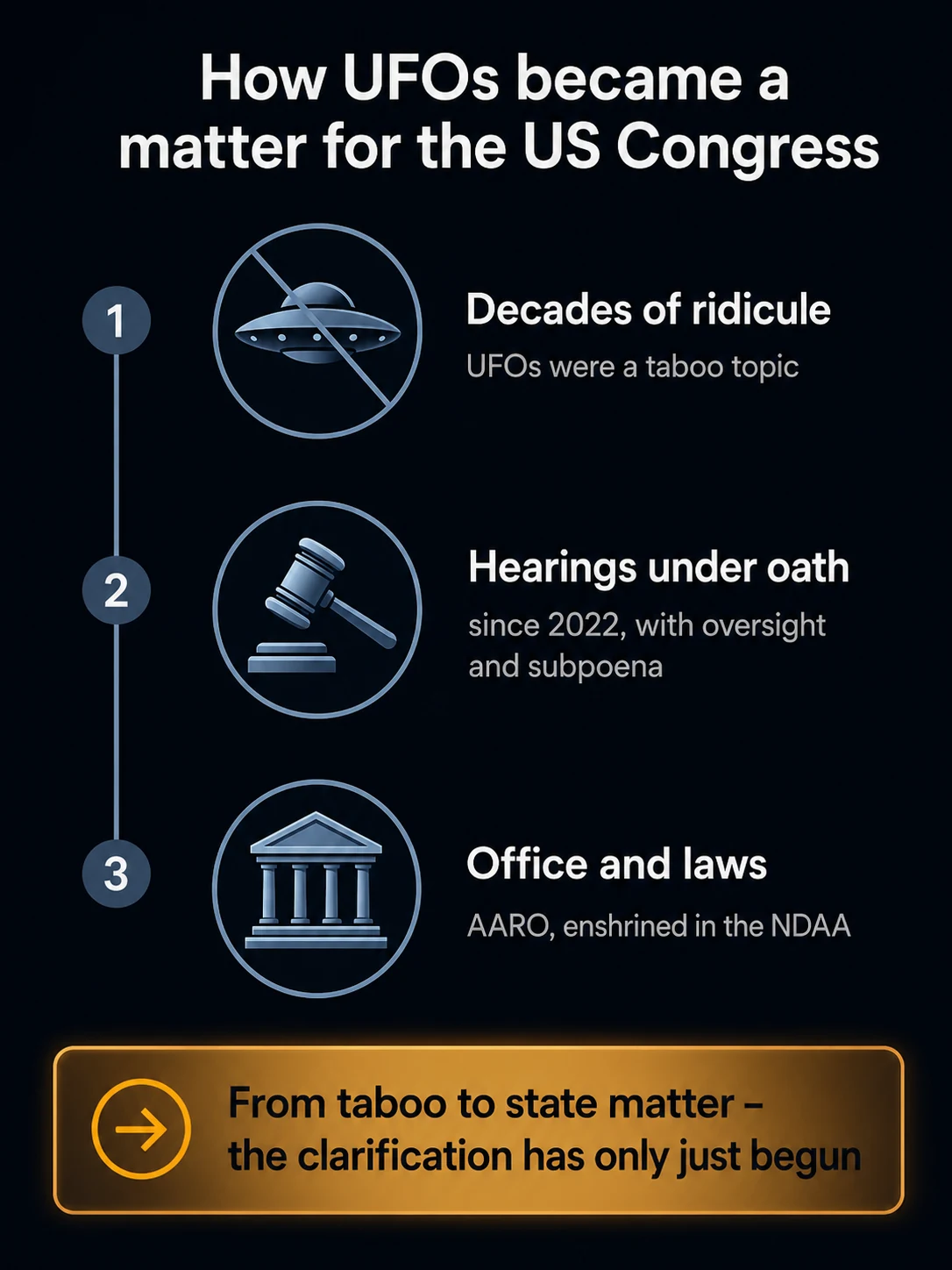
For decades “UFO” was a word for ridicule. Today the topic is heard under oath in the US Congress — with its own office and its own laws. What is remarkable is not a single revelation, but that it is taken this seriously at all.
What does it mean that a once-ridiculed topic is now heard under oath in Congress — and what follows from that, and what does not?
The seriousness shows in the process: sworn witnesses, oversight, laws, a dedicated office. That makes UAP a legitimate subject of inquiry — but it confirms none of the spectacular claims. Legitimate does not mean proven.
This trail separates two things that easily blur: the real change of status (the topic is now handled by the state, under oath, by law) from the question of whether that proves any spectacular claim. By the end you can read a hearing without confusing the two.
KI-generiert (Seedream 4.5, From Beyond Space)
Context
What a congressional hearing actually is
A hearing is an oversight instrument: Congress summons witnesses, swears them in, and can compel testimony and records — to inform legislation and control.
What matters is what the instrument does: testimony under oath carries penalties, a subpoena can compel documents. That this serious tool is now being applied to a once-ridiculed topic is the real change of status — regardless of what individual witnesses claim.
KI-generiert (Seedream 4.5, From Beyond Space)
Open vs. behind closed doors
Hearings have two faces: the public session you can stream — and the classified SCIF session from which nothing leaves.
SCIF stands for “Sensitive Compartmented Information Facility” — a shielded room for classified matters. This is exactly where the decisive statements run: the claim is named in public, examined behind closed doors. For the public, often only the headline remains.
The teeth: oath and subpoena
Two things give a hearing weight: the oath (false testimony is a crime) and the subpoena, which can compel documents and witnesses.
Perjury before Congress is punishable (e.g. 18 U.S.C. § 1621) — which raises the risk of a bald-faced lie. But it does not automatically make a statement true: sincerely believed yet unproven claims are not perjury either. The oath disciplines honesty, not the evidence.
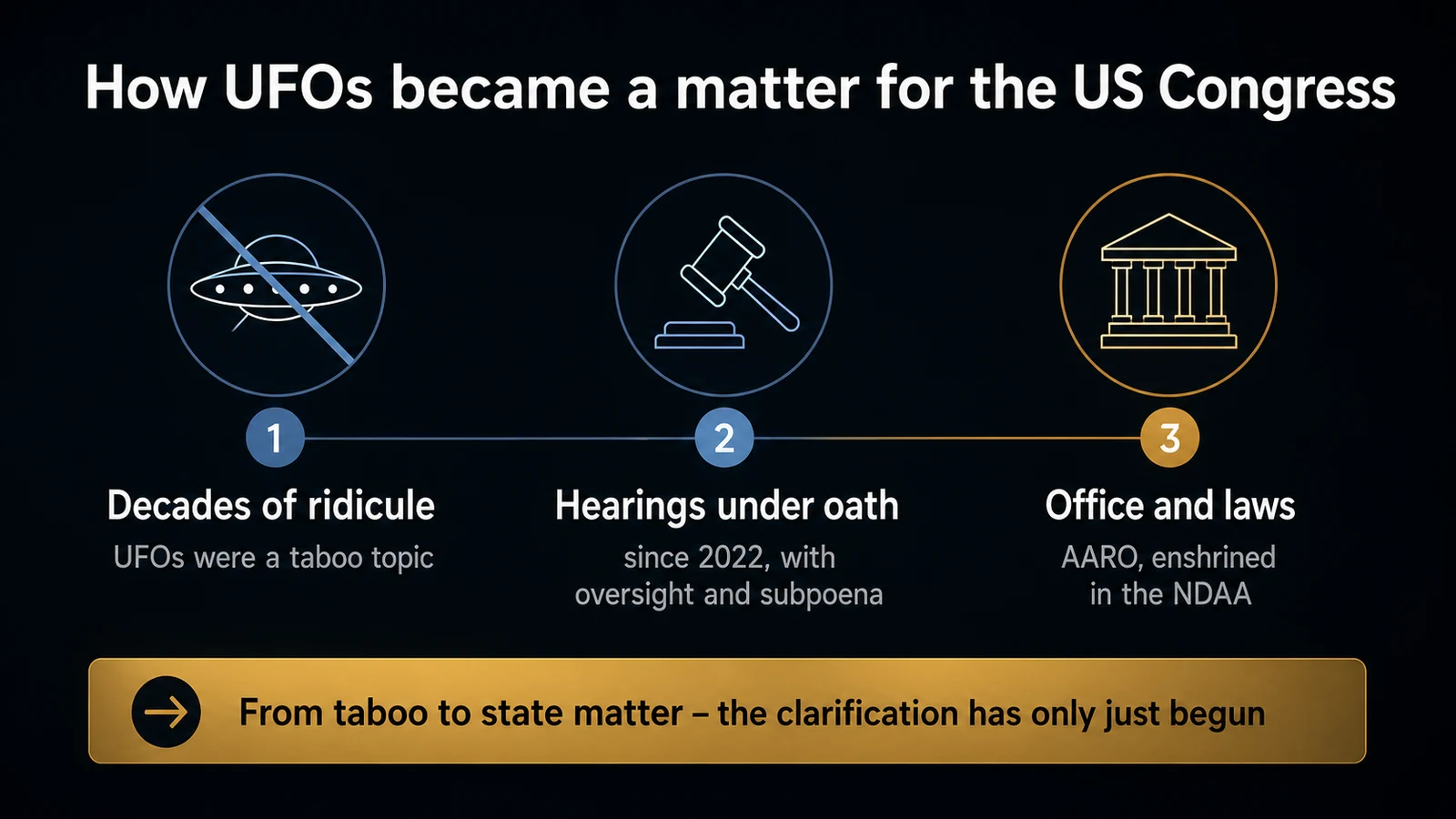
Graphic illustration · KI-generiert (GPT-Image-2, From Beyond Space), faktengeprüft
Turning point
confirmedHow the topic left the disreputable corner
After 1968 the topic lay dormant for decades. Only press reports in 2017, authenticated Navy videos, and a 2021 government report cleared the path to the first hearing in over 50 years.
The turning point was a convergence: the 2017 NYT report made the topic respectable in the media, the 2021 ODNI report provided an official data basis — and on 17 May 2022 came the first public congressional hearing since 1968.
- 1968
Last hearing
symposium — then stigma
- 2017
NYT & Navy videos
serious reporting
- 2021
ODNI report
officially to Congress
- 2022
First hearing
public, under oath
- 2025
It continues
further hearings
The 2017 trigger
A New York Times report on a secret Pentagon program and three Navy videos brought the topic out of the niche into the mainstream press.
The December 2017 report made the previously secret AATIP program public and showed videos the Navy later confirmed as genuine. From then on “UFO” was no longer a purely tabloid topic, but a question of flight and national security.
The long pause before
Between 1968 and 2022 there was no substantial public congressional hearing for over half a century — the stigma held.
After the 1968 symposium and the closure of Project Blue Book in 1969, the topic was officially considered settled. Anyone still taking it seriously risked ridicule — precisely this barrier explains why the way back into Congress took over 50 years.
Claim
confirmedWhy this is a real change of status — not just PR
The hearings produced something lasting: a law mandating reporting channels, and a permanent office (AARO). The topic has entered the machinery of government.
The FY2023 NDAA in 2022 mandated reporting procedures and created the legal basis for the All-domain Anomaly Resolution Office (AARO). With the signed defense bill this became a permanent structure with a reporting duty — not a one-off media event.
AARO — what it is and does
The All-domain Anomaly Resolution Office is the central US body for UAP: it collects reports, examines cases, and reports to Congress.
AARO replaced the earlier UAP Task Force in 2022 and has since consolidated responsibility across all domains (air, water, space). Importantly, AARO is an assessment and resolution body — not a mouthpiece for spectacular theses, but their sober counterpart.
The Disclosure Act — what stayed, what fell
In 2023 a bipartisan push sought to systematically release secret files. Part of it became law — the sharpest levers were negotiated out.
The “UAP Disclosure Act” by Schumer and Rounds was modeled on the JFK records law. Watered-down rules for collecting UAP files made it into law. Cut in the compromise were the two sharpest instruments: an independent review board and a federal eminent-domain power over “recovered technologies of unknown origin.” Both were to be reintroduced, according to the sponsors.
Context
The engine behind it: a struggle over transparency
Why ever more hearings? Because the fight is less about “do UFOs exist?” than about disclosure: what belongs in the open — and what stays classified?
Much came into the open: hearings, ODNI reports, released videos. Yet the core of many statements sits in closed SCIF sessions — witnesses, as in the 2023 hearing, repeatedly note they can only give specifics behind closed doors. It is precisely this tension that drives the call for more disclosure.
Hearings under oath, the ODNI reports from 2021, released Navy videos, the AARO reports. The frame of the topic is now inspectable.
Core details run through classified SCIF sessions. For the public, exactly the contested part often stays unverifiable — that is the friction point.
KI-generiert (Seedream 4.5, From Beyond Space)
Whistleblower protection by law
So that insiders can speak at all, Congress created protected reporting channels: anyone who gives AARO information is released from certain secrecy obligations.
The FY2023 NDAA (e.g. §§ 1673, 1683) required the Defense Department to set up reporting procedures across classification levels and built in whistleblower protection. The idea: without a safe channel, knowledge stays locked in the classified files — protection is the precondition for oversight.
Why witnesses evade
“I can’t discuss that in open session” is not evasion out of spite — often the statement is simply classified.
This creates an asymmetry: the exciting claim is made in public, the evidence sits in secrecy. Anyone not accounting for this quickly reads caution as cover-up — yet either or neither may be true. That is exactly why separating testimony from evidence matters so much.
Thinking trap
“Taken seriously” does not mean “proven”
That Congress takes up a topic makes it a legitimate subject of inquiry — not a confirmed fact. One is a status, the other is evidence.
The danger runs both ways: downplaying the change of status misses the real institutionalization. Overstating it reads “is being seriously investigated” as “is proven.” Between ridiculed and proven lies a wide field — and that is exactly where the topic sits: seriously examined, open at its core.
Actually: seriously examined — but open at its core.
The trap in one sentence
“Congress is taking it up” ≠ “it is proven.” One says something about the status of the topic, the other about the evidence.
Thinking trap
disputedWhat was said, but not proven
The most spectacular claim — secret retrieval programs, “non-human biologics” — comes from a hearing. What is documented is the testimony, not its content.
Here everything separates: that David Grusch testified under oath in 2023 is a real, documented event. But his claims about retrieval programs rest on third-party accounts — by his own account he had no direct access. The 2024 AARO historical report found no empirical evidence for them.
Grusch testified under oath on 26 July 2023; he was an intelligence officer and a representative on the UAP Task Force. His whistleblower complaint was procedurally deemed “credible and urgent.”
A decades-long retrieval and reverse-engineering program and the recovery of “non-human biologics” — from hearsay, without direct access. AARO disputes this: no verified evidence.
KI-generiert (Seedream 4.5, From Beyond Space)
Grusch — who he is
David Grusch is a former US intelligence officer who worked in government UAP bodies — not an outsider, but an insider with security clearance.
That is exactly what gives his testimony weight: he was an NRO and NGA representative on the UAP Task Force. But his credibility as a person and the provability of his claims are two different things — he himself described his knowledge as coming from third parties.
What AARO officially counters
The official counter-finding is clear: no empirical evidence that the US government possesses or reverse-engineers extraterrestrial technology.
The AARO historical report Volume I of March 2024 classifies the retrieval narrative as largely “circular reporting” by a small circle of people. An allegedly extraterrestrial piece of metal is said to be of earthly origin. The report is itself a source with a mandate and limits — but it is the most documented counter-statement there is.
Open question
What you can now place
You can now read a hearing: the change of status is real, the process is sober — and the biggest claims stay open.
The real question stays open: does taking it seriously lead to genuine clarification — or does it stay at negotiating, hearing after hearing? That is exactly why the next look at the basic terms, and at UAP as a long-since worldwide topic, pays off.
KI-generiert (Seedream 4.5, From Beyond Space)