Topic · Basics & terms · 2026-07-17
Must a UFO be extraterrestrial?
A light in the sky nobody can explain — and the mind instantly says “extraterrestrial.” Yet between “unidentified” and “alien” lies a whole field.
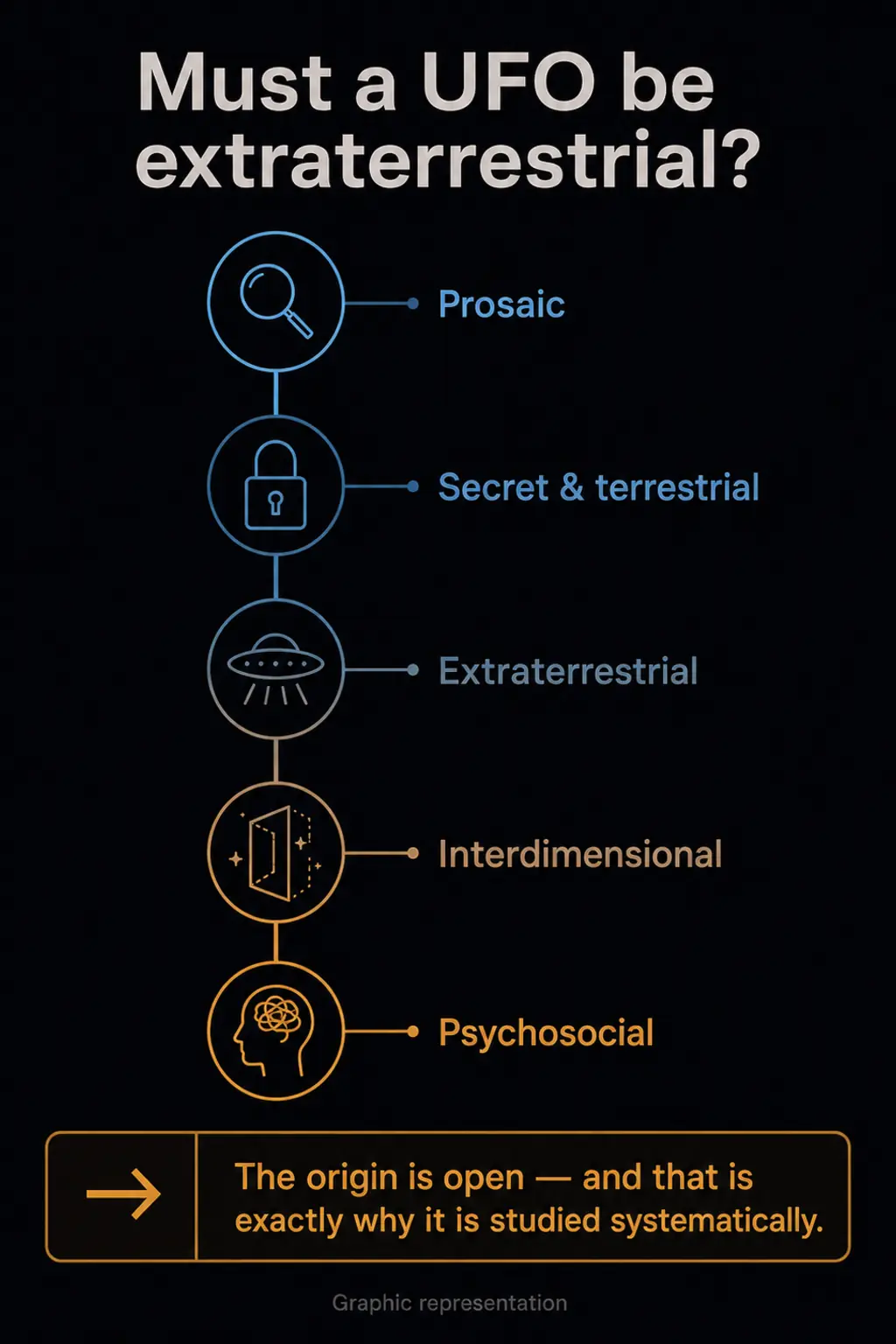
Must a UFO be extraterrestrial — or is “extraterrestrial” just the loudest of many hypotheses?
No origin is proven. Serious research deliberately keeps several scenarios open and measures, rather than committing early.
This trail shows how many origin explanations sit between “unidentified” and “alien” — and why research picks none of them prematurely. It builds on the topic What is a UFO?.
KI-generiert (Seedream 4.5, From Beyond Space)
Context
confirmedThe ordinary first
The vast majority of sightings resolve prosaically: balloon, drone, satellite train, planet, or sensor error.
Of the 12,618 cases in Project Blue Book only 701 remained “unidentified” in the end — the rest were known objects and phenomena. Modern programs also explain most reports as ordinary. “Rule out the obvious first” is not dismissal, it is method.
The vast majority ends up on the left — only a small remainder stays open.
The usual suspects
Venus as the brightest “star,” weather balloons, drones, Starlink trains, birds in infrared, lens glare, and parallax — the most common resolutions.
And what if it is terrestrial but secret?
Some UAP could be secret terrestrial prototypes — one’s own or a rival’s military technology. A terrestrial origin, just not an ordinary one.
Historically real: early “UFO” waves partly coincided with tests of secret reconnaissance aircraft. This hypothesis explains advanced-looking technology without exotic physics — but does not cover the cases where no known platform fits.
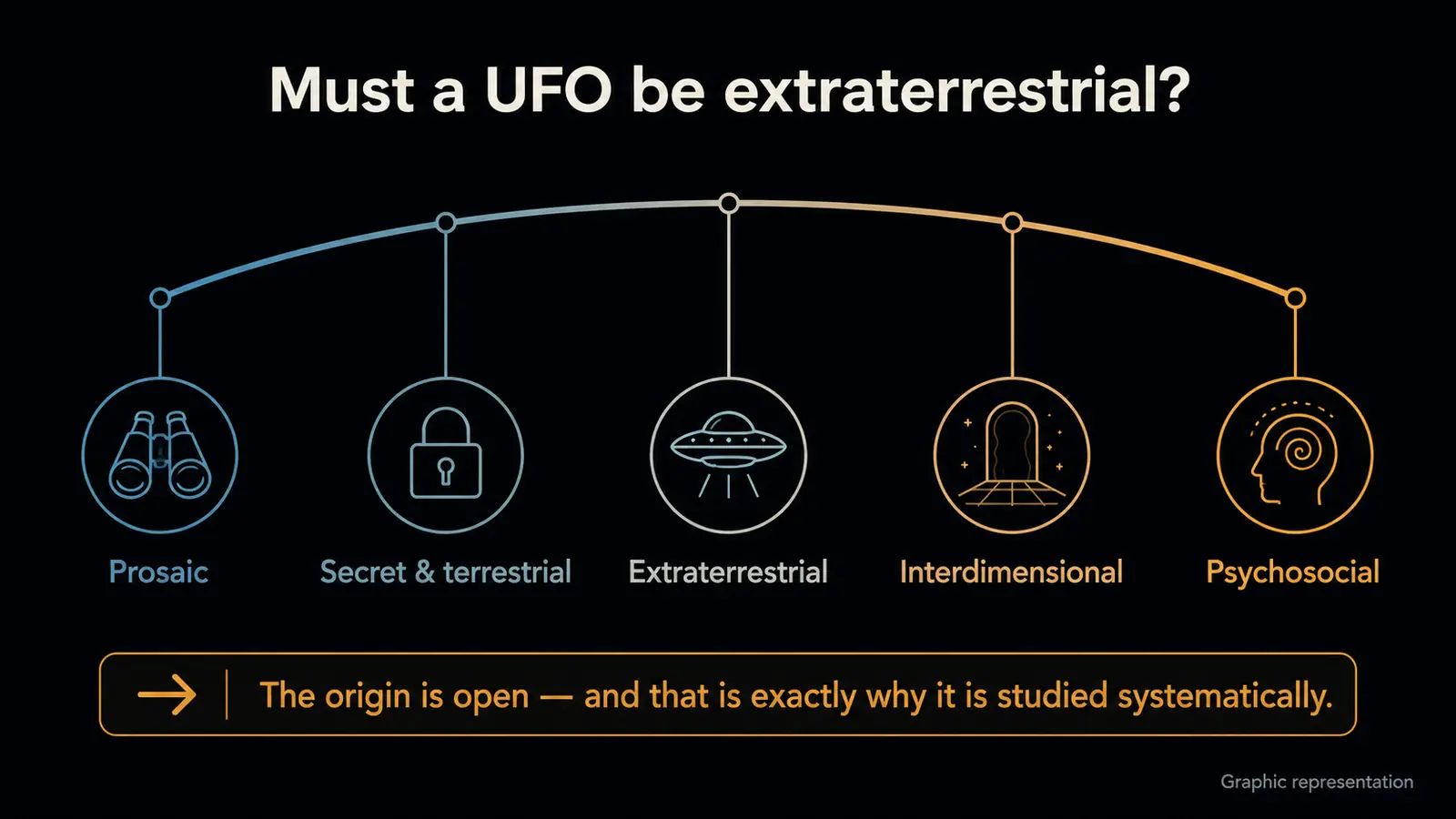
Graphic illustration · KI-generiert (GPT-Image-2, From Beyond Space), faktengeprüft
Thinking trap
The remainder does not automatically make it extraterrestrial
If a small unexplained remainder is left, that only means: too little data. “Extraterrestrial” is then one of several doors — not the only one.
In science, extraterrestrial life is the “hypothesis of last resort” — the answer you reach for only after all closer ones are ruled out. An unexplained case is a reason to keep measuring, not proof of a visit from the stars.
Context
The spectrum of origin hypotheses
Between “banal mistake” and “visit from the stars” lies a whole field of seriously discussed ideas. Swipe sideways through them.
None of these hypotheses is proven — they are models of thought with differing plausibility and each with its own weakness. Roughly ordered, they range from “terrestrial but hidden” to “exotic from elsewhere.”
One sighting, many possible explanatory paths — the fan of hypotheses, shown symbolically.
KI-generiert (Seedream 4.5, From Beyond Space)
The extraterrestrial hypothesis (ETH)
The most popular assumption: UAP are craft of extraterrestrial civilizations. The most intuitive — and the hardest to reconcile with the distances in space.
The strongest counterargument is the enormous interstellar distances (Fermi paradox): why would visitors come often — and where is the unambiguous evidence? Official programs find none so far. That is why, methodically, it counts as the hypothesis of last resort.
The interdimensional hypothesis (IDH)
Not distant planets but a coexisting reality: Jacques Vallée saw a line from old folklore to modern encounters.
Vallée (“Passport to Magonia,” 1969) and Hynek/Vallée (“The Edge of Reality,” 1975) read UAP as a real but unknown phenomenon “at the edge of reality.” Weakness: barely falsifiable — “other dimensions” without testable physics explain everything and thus nothing.
The cryptoterrestrial hypothesis
The intelligence would not be extraterrestrial but hidden on Earth — underground, in near-Earth space, or “among us.”
A scholarly paper by Lomas, Case, and Masters (The Cryptoterrestrial Hypothesis, 2024) explicitly argues for “scientific openness” — not for the truth of the thesis. Physical evidence is lacking; even in expert circles it is treated as highly speculative.
Time travelers from our future
A fringe position: UAP would be piloted by human descendants visiting their own past — the “greys” would be future humans.
Proposed by anthropologist Michael Masters (“Identified Flying Objects,” 2019). Even among UFO authors it is considered extremely implausible: there is no known physics for macroscopic time travel, and causality paradoxes remain unresolved.
The psychosocial hypothesis
Perhaps “UFO” is not a flying object at all but a modern myth — a mirror of our fears and longings.
C. G. Jung (“A Modern Myth,” 1958) read UFOs as an archetypal image, without judging their physical origin. Weakness: it explains perception and culture well — but not the few cases with concrete radar and instrument data.
Claim
confirmedWhat science actually says today
No official program has ever found evidence of extraterrestrial technology — and at the same time a small remainder of cases stays unexplained.
The NASA UAP report 2023 states: no evidence of extraterrestrial origin. The AARO Historical Record Report 2024 found not a single case of off-world technology. Both also say: the data is too thin — better measurements are needed, not quick verdicts.
- 2021
ODNI report
first official assessment
- 2022
AARO established
dedicated Pentagon office
- 2023
NASA report
no evidence of ET origin
- 2024
AARO Volume I
no case of off-world tech
Measure, don’t believe
The Galileo Project (since 2021) systematically collects open sensor data instead of anecdotes — with no premise about which explanation ultimately holds.
What is documented — and where interpretation begins
What is documented is the outcome of the investigations: no ET evidence, a remainder stays open. Which hypothesis explains that remainder is interpretation.
The distinction is this topic’s learning anchor: an open case makes a hypothesis worth checking — it does not confirm it.
NASA (2023) and AARO (2024): no evidence of extraterrestrial origin; a small share of cases stays unexplained with today’s data.
Which of the hypotheses (terrestrial-secret, extraterrestrial, interdimensional …) explains the open remainder — that is so far unproven and under debate.
Thinking trap
Why the origin question is so hard
Each hypothesis explains some things well and others not at all. None covers every case — and that is exactly what keeps the field open.
The extraterrestrial hypothesis wrestles with the distances, the interdimensional and cryptoterrestrial ones with falsifiability, the psychosocial one with hard radar data. Seriousness here means naming the weaknesses, not defending a favorite idea — and following a fixed checking path.
Open question
What you can now say
“Unidentified” does not mean “extraterrestrial” — and “extraterrestrial” is one hypothesis among several, none proven.
The honest answer to “Must a UFO be extraterrestrial?” is: no — it need not be anything except unexplained. Which explanation ultimately holds is open. And precisely that openness makes systematic research so compelling.

KI-generiert (Seedream 4.5, From Beyond Space)