Topic · Sightings & visual evidence · 2026-07-20
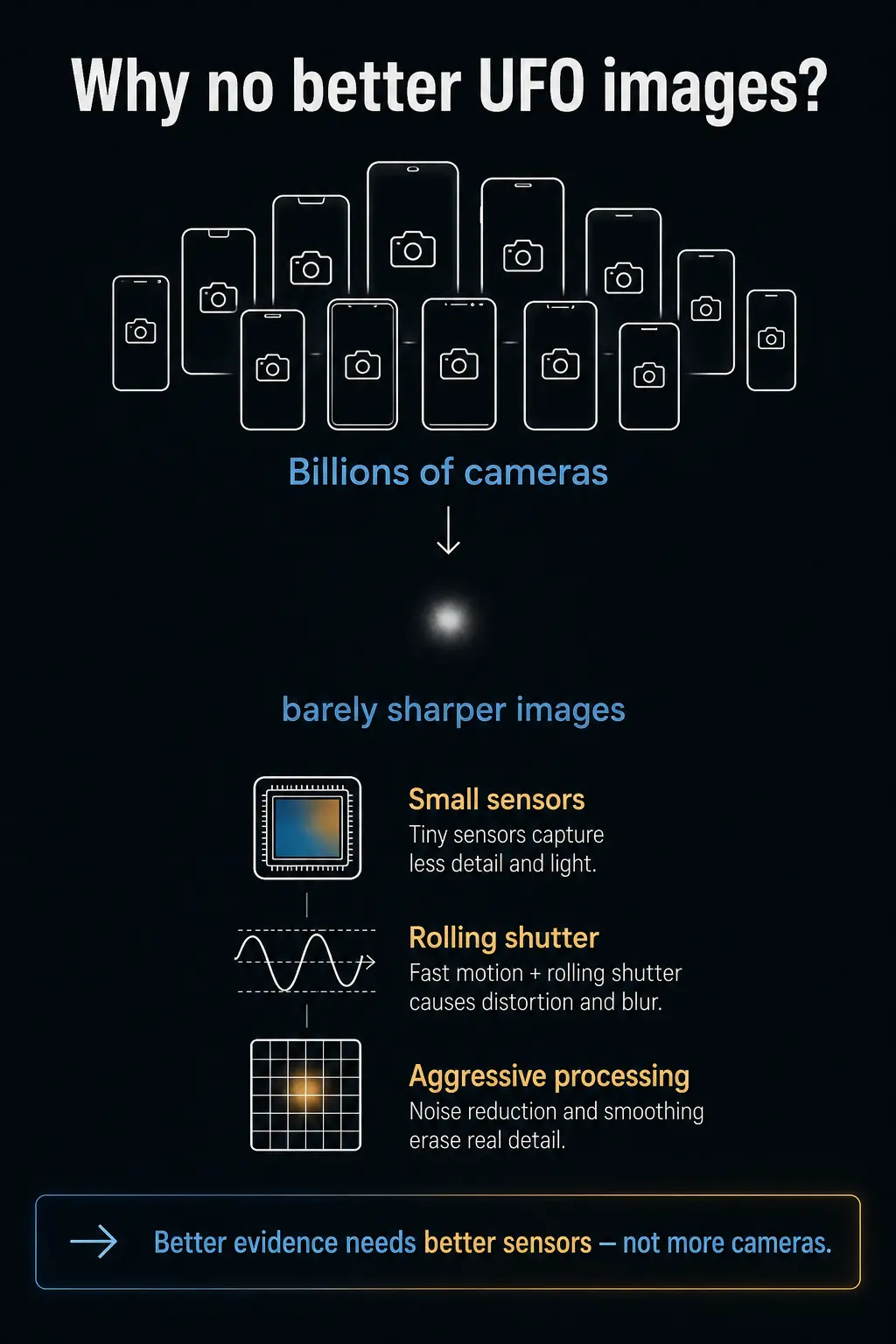
Why no better UFO images — despite billions of phone cameras?
Billions of cameras sit in our pockets — yet the sharpest UFO images are still often decades old.
Almost everyone carries a camera — so why don’t UFO images get sharper, but often even worse?
Image quality is a technical problem, not proof for or against anything. Phone cameras are optimised for everyday subjects — not for small, distant, fast objects in the sky.
This spine shows: the answer lies in the technology, not the subject. A phone camera is a small miracle for selfies and holiday snaps — and precisely for that reason poor at capturing a small, distant, fast-moving point of light in the sky. Understanding what such an image is missing also explains why “more cameras” does not automatically mean “better evidence.”
KI-generiert (Seedream 4.5, From Beyond Space), Illustration
Context
Why a phone barely sees the sky
A tiny sensor and a short focal length reduce a distant object to a handful of pixels. Digital zoom then only magnifies the noise.
A phone’s image sensor is roughly the size of a fingernail and gathers correspondingly little light. Its fixed optics have a short focal length — great for everyday wide angles, poor for the distant: an object in the sky often covers only a few pixels. Optical zoom would require real, longer glass; the pinch-to-“zoom” is usually just digital zoom that crops and upscales — without gaining a single new piece of image information. Why the images therefore stay structurally blurry is also laid out in an overview by New Space Economy.
The digital-zoom trap
Optical zoom moves real glass and gathers real detail. Digital zoom merely crops — and guesses the rest.
On a phone almost everything beyond the main lens is at least partly digital zoom: the image is cropped and upscaled back to full size. No new detail can arise from this — only a smoother or estimated version of what were already just a few pixels. That is exactly why a “zoomed-in” UFO often looks mushy rather than sharper.
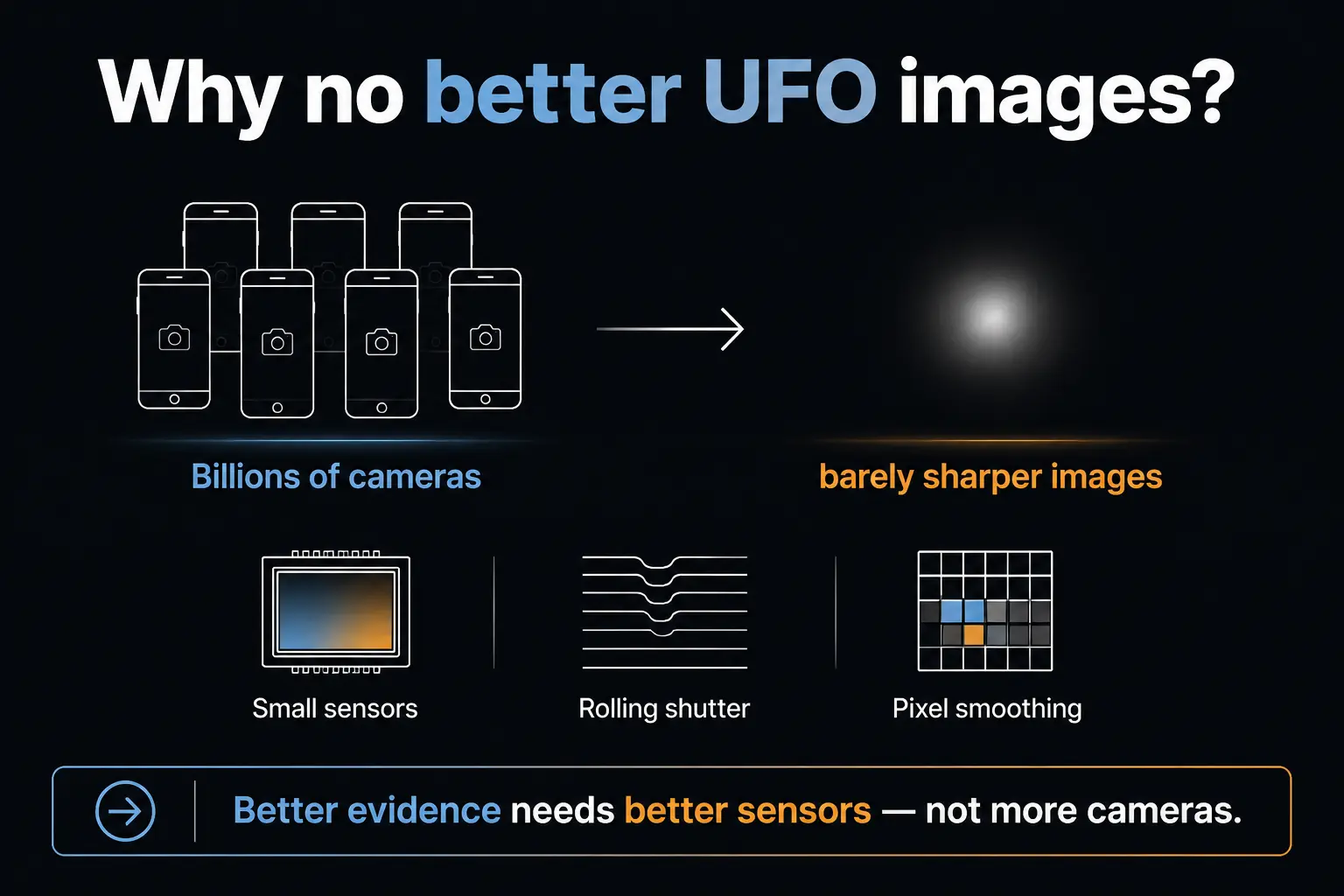
Graphic illustration · KI-generiert (GPT-Image-2, From Beyond Space), faktengeprüft
Thinking trap
When fast objects bend
Phone sensors read the image line by line. With fast objects, something mundane can turn into a seemingly impossible shape.
Most phones use a “rolling shutter”: the sensor does not expose the whole frame at once but reads it out line by line, top to bottom. If an object moves fast within those fractions of a second, it is already elsewhere by the lower lines — straight edges appear slanted, shapes “wobble” (the jello effect). Planes, birds or lightning thus become seemingly exotic forms. Skeptics have resolved exactly such cases step by step, for instance a “beam of light” over a Mayan pyramid as lightning plus rolling shutter.
Thinking trap
Your phone invents sharpness
Modern cameras smooth and sharpen images with AI. Brilliant for everyday photos — for distant anomalies they erase or invent detail.
A phone photo today is not a plain sensor readout but a computed result: multiple frames are combined, noise smoothed, edges sharpened, resolution upscaled by AI. For known subjects — faces, text, landscapes — this works astonishingly well. But a small, unknown point of light fits no learned pattern: it is either smoothed away as noise or “beautified” with plausible-looking yet invented structure. The result looks sharper but often holds less real information. How far this goes was shown by Samsung’s AI-assisted moon photography.
The algorithm knows faces, text, landscapes. It removes noise and sharpens the familiar convincingly.
A distant, unknown dot fits no pattern — it is smoothed away or filled with invented texture. Sharp, but poorer in real information.

KI-generiert (Seedream 4.5, From Beyond Space), Illustration
Were old film cameras more honest?
Film records what light physically leaves behind — no smoothing, no AI. In return it has other limits: resolution, grain, development.
In a narrow sense film is “more honest”: the grain is a physical trace of light, and no software interprets detail in or out after the fact. That is why some old images are harder to manipulate digitally. But it does not mean “everything was better back then”: film is often lower in resolution, offers no instant review, and chemical development brings its own error sources. More honest in detail — not automatically superior.
When AI hallucinates detail
Night mode and strong zoom modes can show structures that are not in the real subject at all.
In 2023 a widely noted experiment showed the principle: a deliberately blurred moon photo was rephotographed with a phone — and suddenly the moon had crisp craters that were no longer present in the blurred original. The device recognised “moon” and overlaid trained texture. For small objects in the sky this is delicate: the camera may add what it “expects” to see, not what was actually there — documented in Samsung’s own description of AI detail enhancement.
Context
More footage — not more proof
There genuinely is more footage today: from navy pilots to phone cameras. But quantity and evidential weight are two different things.
The pile of videos is growing — declassified military footage, countless phone clips, dashcams, bodycams. Except: most of them are low-resolution, short and without context. A shaky video shared a thousand times is no better evidence than a single one — it is simply present more often. Evidential weight comes not from repetition but from data quality: scale, calibration, multiple sensors. That is exactly why the robust single piece of evidence stays rare even as the volume of footage explodes.
Quantity piles up on the left — the evidential weight of a single item does not move right because of it.
The documented case: the Navy videos
In 2020 the Pentagon officially released three Navy videos — genuine, but grainy, infrared and low-resolution.
On 27 April 2020 the US Department of Defense officially confirmed three previously leaked recordings (FLIR, GIMBAL, GOFAST) and made them available through the Navy. Documented is: the videos are genuine military footage, not a fake. Not documented is what they show — they are short, low-resolution infrared clips whose interpretation remains disputed. A perfect example that “authentic” is not the same as “conclusive”; the official release is documented via the Navy.
The three clips are genuine and officially released — origin and recording gear are known.
What the objects are stays open. The low resolution allows several explanations.
Claim
What a truly conclusive image would need
A convincing image needs more than sharpness: a scale, several calibrated sensors at once, and the unprocessed raw data.
A single sharp image is never enough — what matters is whether size, distance and speed can be derived from it, and whether the camera is known and calibrated. This is exactly what scientific approaches aim at: fixed stations with camera, radar and infrared, calibrated optics and stored raw data. Who is trying to build such instruments worldwide is covered in Who actually studies UAP?.
Open question
A camera problem — or nothing to see?
Blurry images prove nothing — in either direction. Above all they show the limits of the camera in your pocket.
The honest answer to the guiding question is: that the images stay poor is exactly what the physics predicts — it argues neither for nor against anything extraordinary. The path to better evidence therefore runs not through even more phones but through better instruments. And the question of what an unexplained object could even be leads on to Must a UFO be extraterrestrial?.