Topic · Evidence & method · 2026-07-21
Ordinary explanations for UFOs
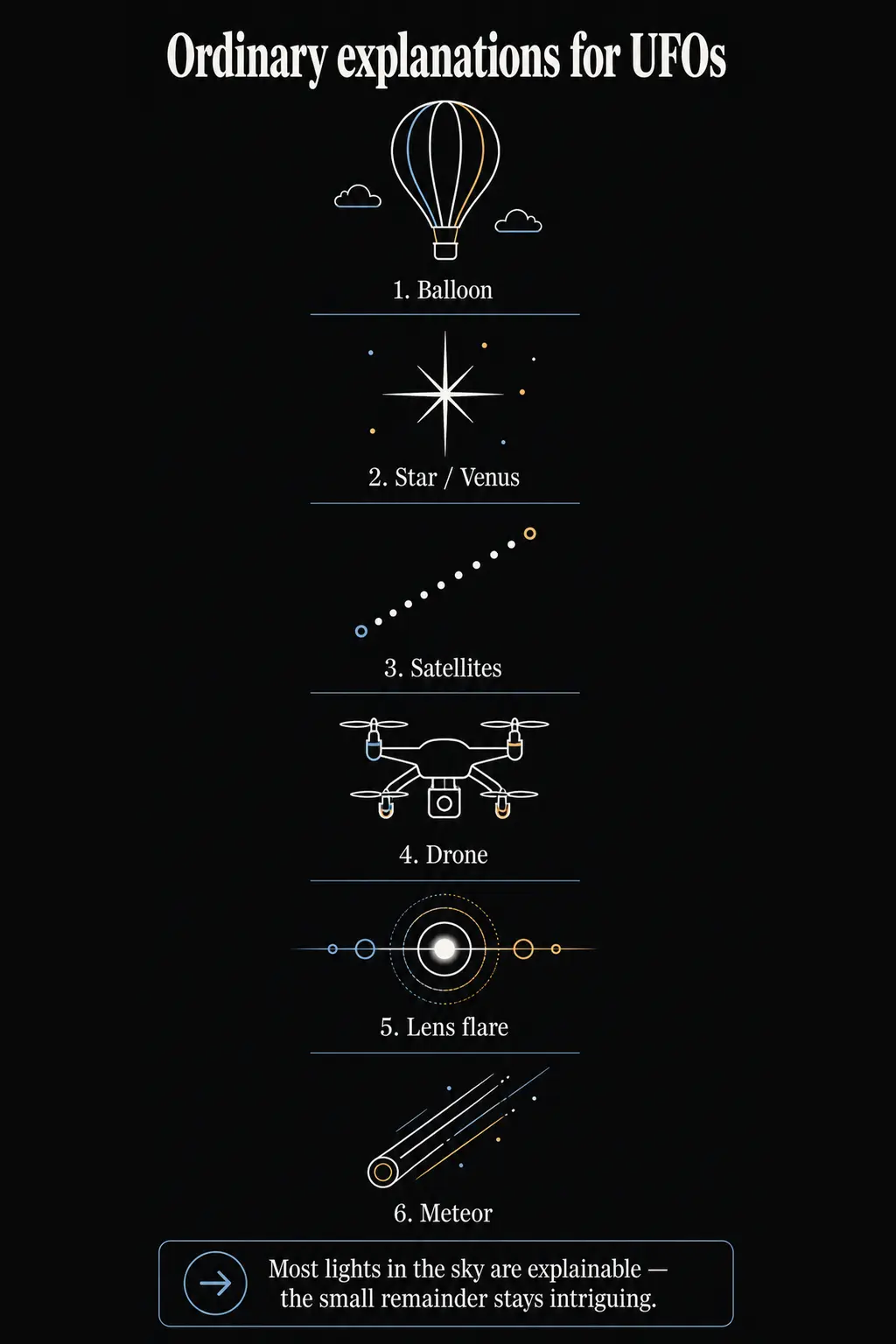
The vast majority of UFO sightings have an earthly explanation — often a surprisingly mundane one. And that is exactly what makes the small remainder interesting.
Before thinking of something extraordinary — which ordinary explanations must a case first survive?
Most sightings resolve prosaically — that disparages no one. It sharpens the eye for the small remainder that truly stays open.
Reporting centres such as the German Society for the Study of the UFO Phenomenon resolve roughly nine out of ten sightings conventionally — from weather balloons to Venus. This spine shows the usual suspects, why the sky deceives us so easily — and what about the small unexplained remainder. More on the GEP’s work at ufo-forschung.de.

KI-generiert (Seedream 4.5, From Beyond Space), Illustration
Context
The usual suspects
Balloons, stars, satellites, drones, birds and insects, camera artifacts, meteors: a handful of candidates explain the bulk of all sightings.
Almost always a sighting lands with one of these candidates. The side-arms show each one — what characterises it and how it gives itself away. It pays to know them: whoever has the usual suspects in mind explains most “UFOs” themselves.
Balloons & sky lanterns
Glowing balloons, weather balloons and sky lanterns drift silently, slowly and with the wind — a classic among reports.
LED helium balloons and sky lanterns are, according to reporting centres, among the most common triggers. Telltale: the silent, even drift with the wind, often in small groups, with warm flickering light (lanterns) or steady colours (LEDs).
Stars & planets — the Venus trap
Low-hanging Venus is the most-reported “UFO.” Near the horizon it twinkles and shifts colour — and seems to wander.
Very bright stars and planets, especially Venus, appear to twinkle and colour through atmospheric turbulence; the autokinetic effect makes them “jump.” Telltale: they return to nearly the same spot every night and move with the starry sky.
Satellites & Starlink trains
A “string of pearls” of even lights moving in a straight line across the sky: freshly launched Starlink satellites.
Individual satellites appear as evenly bright points without blinking, crossing in a straight line within minutes and vanishing into Earth’s shadow. Shortly after a launch Starlinks form the striking train — today one of the most common new reports.
Drones & aircraft
Illuminated drones, approaching aircraft and helicopters explain many “hovering” or “blinking” objects.
Illuminated drones are rising sharply as triggers. Aircraft on approach seem to stand still when heading straight at you; their landing lights look like a single glaring light. Telltale: position lights, blinking, engine sound when the wind is from the right direction.
Camera artifacts
Lens flares, out-of-focus dots (bokeh) and motion blur create “objects” that exist only in the image.
Bright light sources reflect inside the optics and appear as geometric spots; out-of-focus distant lights become round “discs.” Why phone images show this so often is explored in Why no better UFO images?.
Meteors, clouds & mirages
Fireballs, lens-shaped clouds and mirages provide the more spectacular, rarer mix-ups.
A bright fireball (bolide) streaks through in seconds with a tail; lens-shaped lenticular clouds look deceptively “engineered”; mirages distort distant lights into flickering shapes. Rare, but impressive — and therefore often reported.
Birds & insects
An insect right in front of the lens streaks across as a blurry smear; a bird in sunlight becomes a bright disc — both quickly look anomalous in photos.
Animals near the camera deceive twice over. An insect a few centimetres from the lens is out of focus, looks huge and seemingly impossibly fast — the well-known “rods” effect, where wingbeats blur into a jagged trail. Birds reflect sunlight as bright dots or “discs” and lose their recognisable shape at a distance. Telltale: the erratic motion and that the “object” often appears only in single video frames.
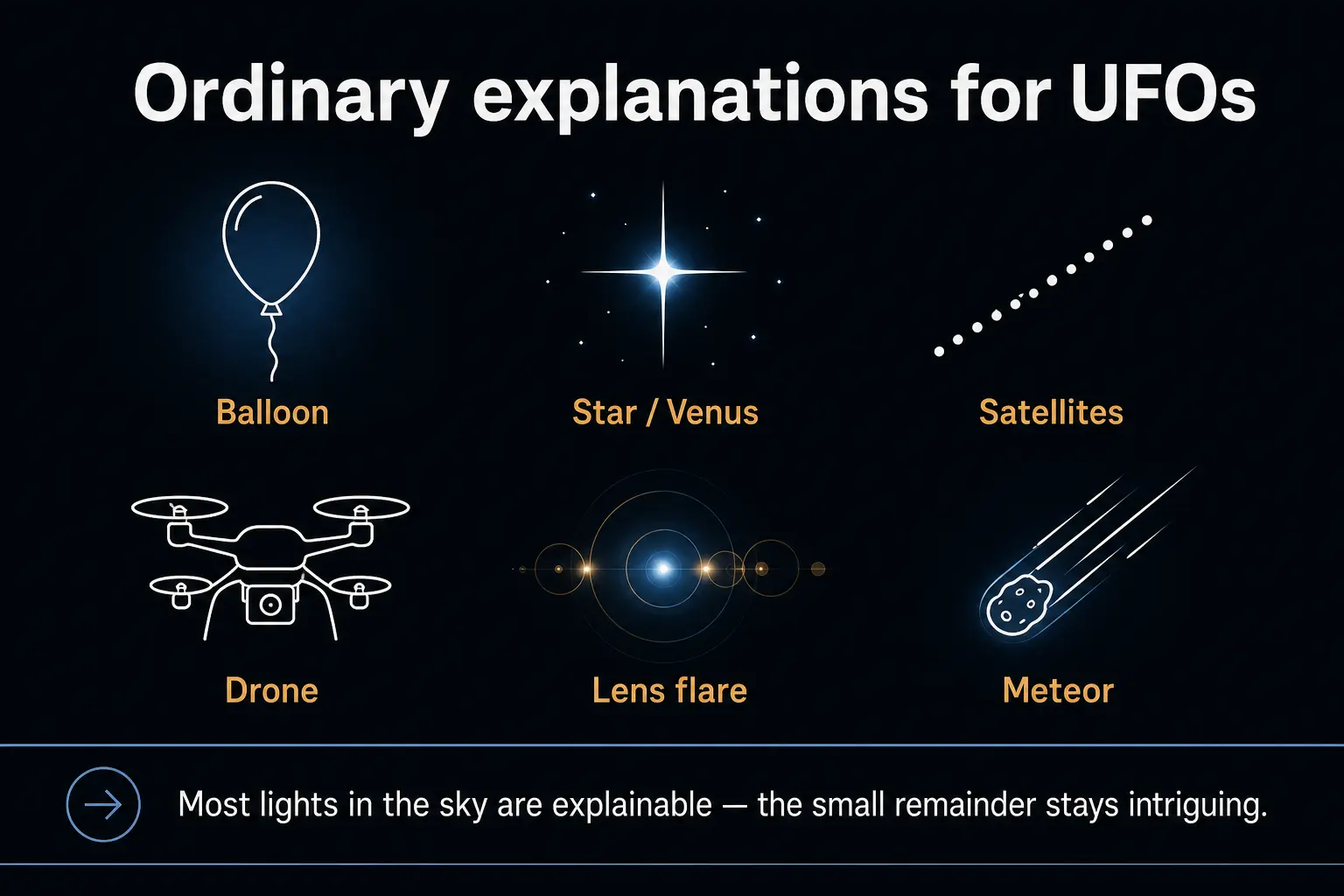
Graphic illustration · KI-generiert (GPT-Image-2, From Beyond Space), faktengeprüft
Thinking trap
Why the night sky deceives us
The dark sky lacks reference points. Without them the eye systematically misjudges size, distance and motion.
A light with no surroundings could be small and near or huge and far — the brain guesses. Fixate a point for long and it seems to move (the autokinetic effect) although it is still. Thus a distant helicopter becomes a “silently hovering object.” Not imagination — normal perception under unfamiliar conditions.

KI-generiert (Seedream 4.5, From Beyond Space), Illustration
Context
How specialists resolve a sighting
From time, place and viewing direction one can reconstruct what was really in the sky — step by step.
Investigators proceed soberly: they gather the key data, cross-check it against star charts, air traffic, satellite passes and weather, and examine what remains. This very care determines how strong a case ultimately is — more under What counts as evidence?.
Thinking trap
A suspicion is not yet an explanation
“That was surely a balloon” is not an explanation but a guess. Only the match with the data makes it one.
Explaining things away too quickly is as unserious as marvelling too quickly. A good explanation fits time, place and direction in a checkable way; a bad debunk merely asserts the most plausible thing. Fairness to witnesses means: check, don’t dismiss — and say openly when nothing fits.
Fits the key data checkably: the satellite was at exactly this place at exactly this time.
Merely asserts the most plausible thing (“surely a drone”), without testing it against the data.
The remainder that stays open
Even after careful examination a small remainder stays unexplained. Not spectacular — but real, and precisely for that reason intriguing.
At the reporting centres a small single-digit percentage regularly remains that cannot be resolved — often because the data is too thin, sometimes even with surprisingly good documentation. This remainder is no proof of the extraordinary, but the actual invitation: it is why serious research keeps measuring at all instead of waving things away.
Open question
Ordinary — or not?
Knowing the usual suspects makes you calmer and more curious at once: most is explainable — and the small remainder all the more interesting.
The honest answer to the guiding question: a case must first survive the ordinary explanations before it is truly puzzling. Almost none do — and that is no disappointment but the precondition for taking the real remainder seriously. What such a remainder would need to be strong is shown in What counts as evidence?.