Topic · Evidence & method · 2026-07-21
What actually counts as evidence — and what is just a claim?
A video alone rarely convinces. What truly makes a UFO case strong is something else — and often invisible at first glance.
If a video alone often isn’t enough — what then makes a UFO case truly robust?
A case does not become strong through spectacle, but through source, data, context and the ruling-out of alternatives. “Officially documented” does not mean “extraordinarily proven.”
This spine shows how to assess a UFO case seriously: with clear language for sighting, evidence and proof, an evidence ladder, and a few thinking traps worth knowing. It is the methodical core — the other themes point back here, for instance Why no better UFO images?.
KI-generiert (Seedream 4.5, From Beyond Space), Illustration
Context
Sighting, report, evidence, proof — four words not to confuse
These four terms stand for four levels of certainty. Keeping them apart is already half the battle.
In everyday talk the terms blur — in serious handling they don’t. A sighting is an experience; a report records it; evidence is a checkable trace; proof rules out the alternatives. Most “proof photos” are in truth pieces of evidence — often not even that.
Graphic illustration · KI-generiert (GPT-Image-2, From Beyond Space), faktengeprüft
Context
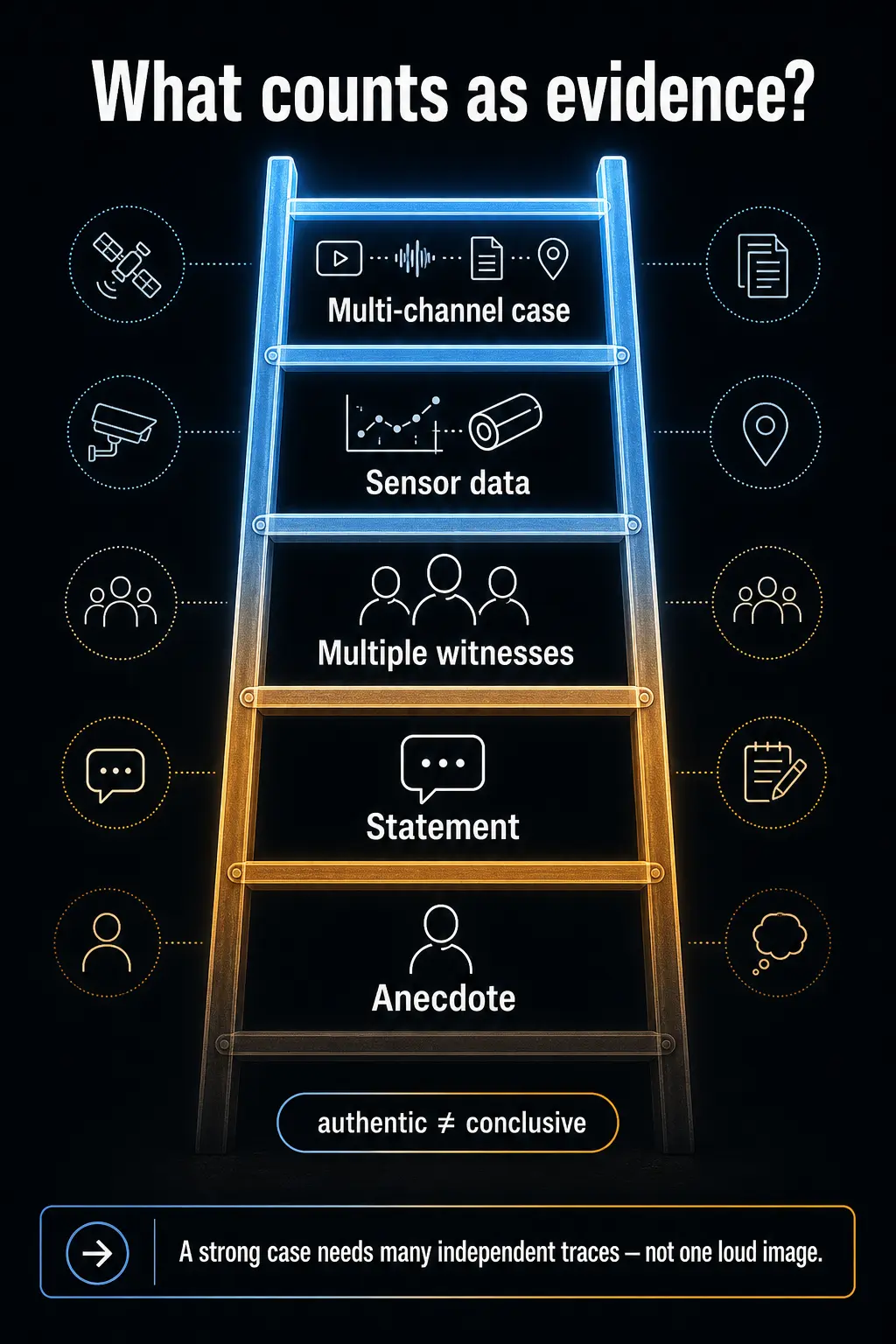
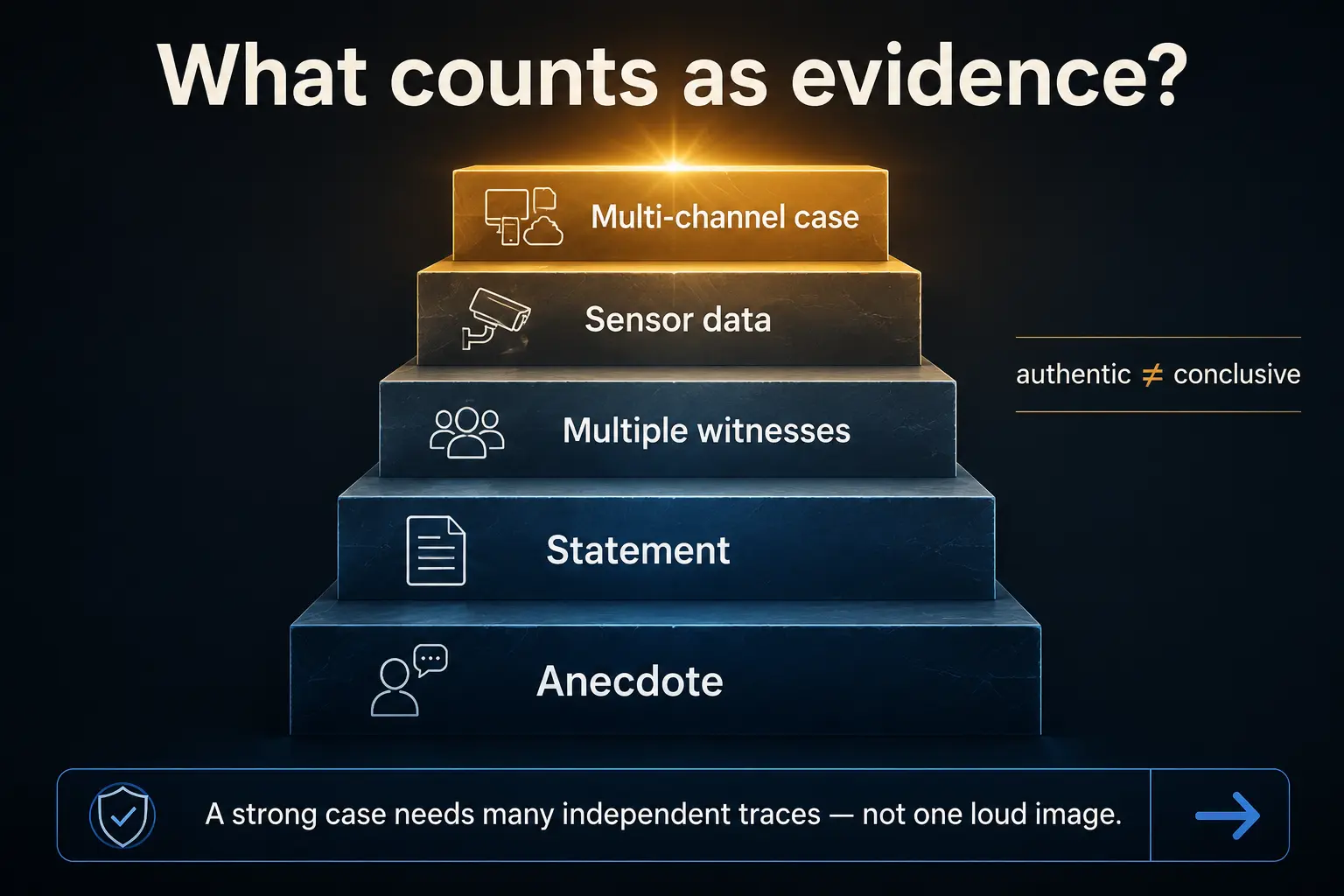
The evidence ladder: from anecdote to multi-channel case
Evidence is not all equally strong. It can be ranked on a ladder — from a mere anecdote to a case with several independent data sources.
The higher on the ladder, the harder a case is to explain away. What matters is not drama but how independent and checkable the traces are. A shaky phone clip sits low down — several sensors plus witnesses plus records sit high up.
Historical vs. scientific evidence
A case can be strong in two ways: well documented in sources — or well measured in data. Each answers a different question.
Historical evidence asks: which sources exist, how close to the event, how reliable? It can show well that something was reported or investigated — not automatically what the object was. Scientific evidence asks for measurable data, calibration and reproducibility. Strong cases ideally have both.
Prompt, independent sources, clear archival provenance. Shows that something was reported/investigated.
Measurable data, calibration, error sources checked, reproducible. Tests what the object was.
Thinking trap
Authentic is not the same as conclusive
That a video is genuine and official says nothing about what it shows. Origin and evidential weight are two different questions.
A textbook example: in 2020 the Pentagon officially released three Navy videos — that settles their origin; the videos are not fakes. Yet what the objects are stays open; the low resolution allows several explanations. “Confirmed genuine” is a statement about the source, not the interpretation — more via the official release.
The videos are genuine and officially released — origin and recording gear are known.
What the objects are stays open. The low resolution allows several explanations.
KI-generiert (Seedream 4.5, From Beyond Space), Illustration
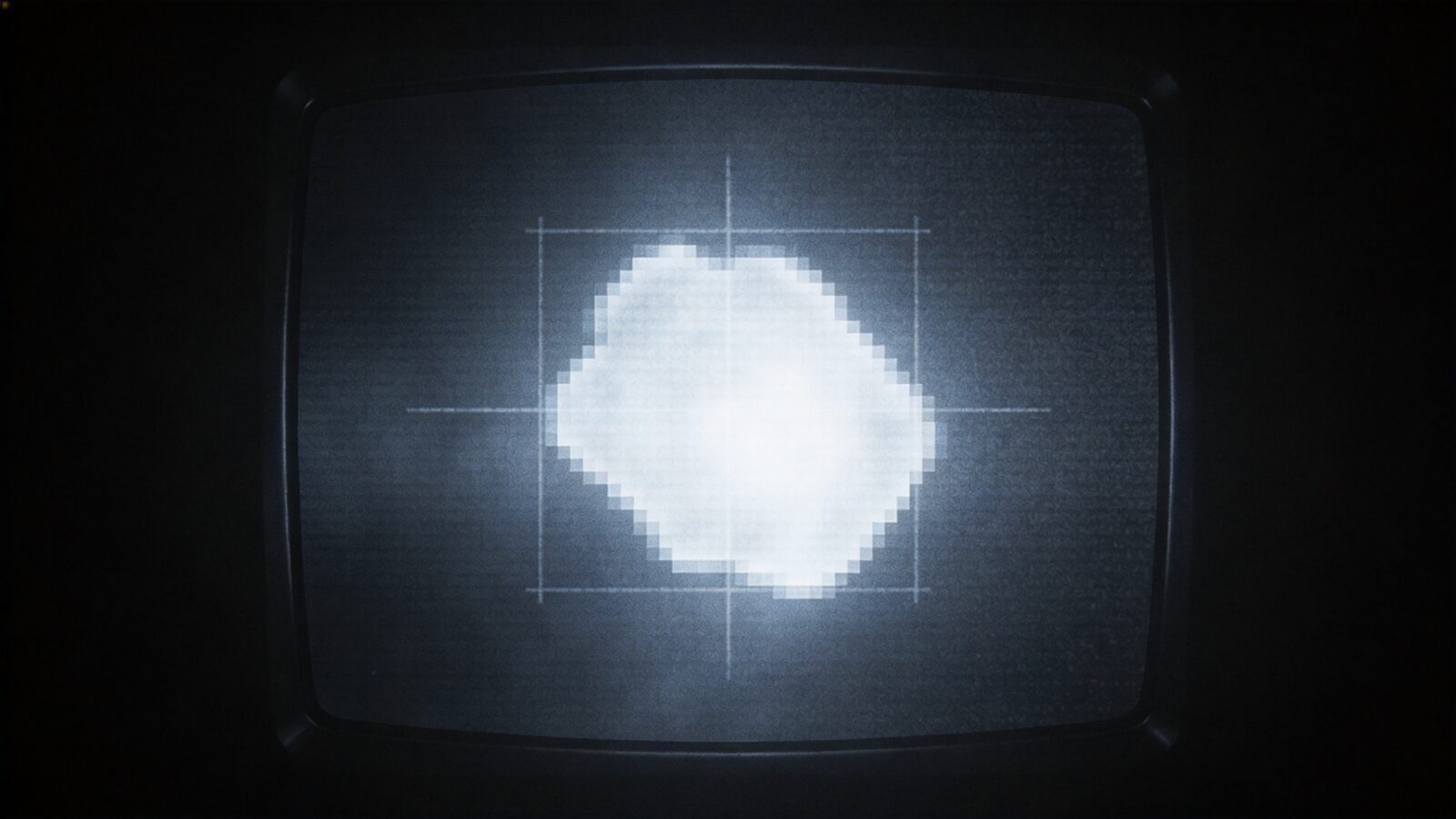
Example: the released Navy videos
Released means: origin settled. It does not mean: interpretation settled. That very line makes the videos a teaching case.
On 27 April 2020 the US Department of Defense officially confirmed three recordings (FLIR, GIMBAL, GOFAST). This documents their authenticity — not what is shown. If you are interested in the image quality itself, see Why no better UFO images?.
Thinking trap
“Unexplained” does not mean “extraordinary”
That a case stays open is usually down to thin data — not to something supernatural. “Not explained” and “inexplicable” are not the same.
An open case is an invitation to keep checking, not evidence for the spectacular. If time, distance, weather or sensor data are missing, a case stays unexplained — no matter how ordinary the object may have been. The honest stance: keep it open, keep measuring, don’t escalate early.
Most open cases sit on the left — thinly documented, not supernatural.
Claim
How to recognise a strong case
A robust case withstands four checks: source, data, context, and the ruling-out of ordinary explanations.
These four axes are the core of assessment — not the question “alien or not.” They apply to a historical case just as to a Navy recording. Working through them almost always yields a sober but honest classification — and sometimes the question from Must a UFO be extraterrestrial?.
Chain of custody: why the origin must be unbroken
Evidence is only as strong as its traceable origin — from sensor to analysis, without a gap.
“Chain of custody” means the unbroken chain: where did the recording arise, who secured it and when, was it passed on unchanged, who analysed it? If a link is missing, even good material stays vulnerable — not because it is false, but because it can no longer be checked cleanly.
Open question
So: what would actually convince you?
Good evidence is not a matter of awe but of testability. Once you know what makes a case strong, you read every headline differently.
The honest answer to the guiding question: a case becomes robust through many independent, checkable traces — not through one loud image. That is exactly why spectacular footage often stays weak while unremarkable multi-channel cases are strong. How hard good images are to get at all is shown in Why no better UFO images?.