Topic · Thinking tools & scepticism · 2026-07-22
Believing too fast, dismissing too fast
Some believe every sighting, others laugh at every one. Both feel certain — and both are wrong surprisingly often.
Why are both sides often wrong about UFOs — those who believe everything and those who dismiss everything?
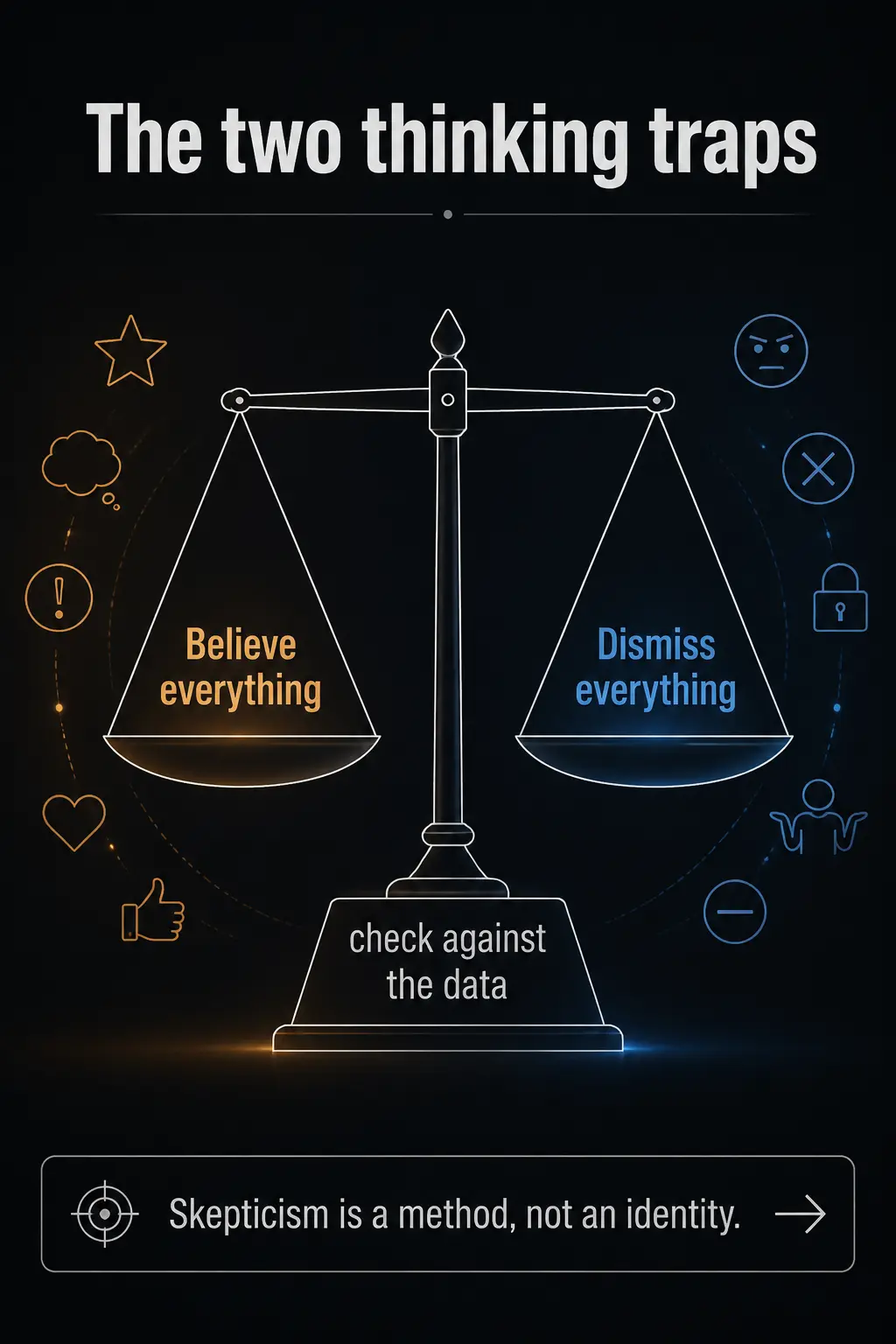
Believers and debunkers make mirrored errors; the cure is the same on both sides. Skepticism is a method, not an identity.
This spine shows the two mirrored thinking traps — believing too fast and dismissing too fast — and the one method that dissolves both. It is not about picking a camp, but about keeping the question open and the checking honest.

KI-generiert (Seedream 4.5, From Beyond Space), Illustration
Context
Between credulous and know-it-all
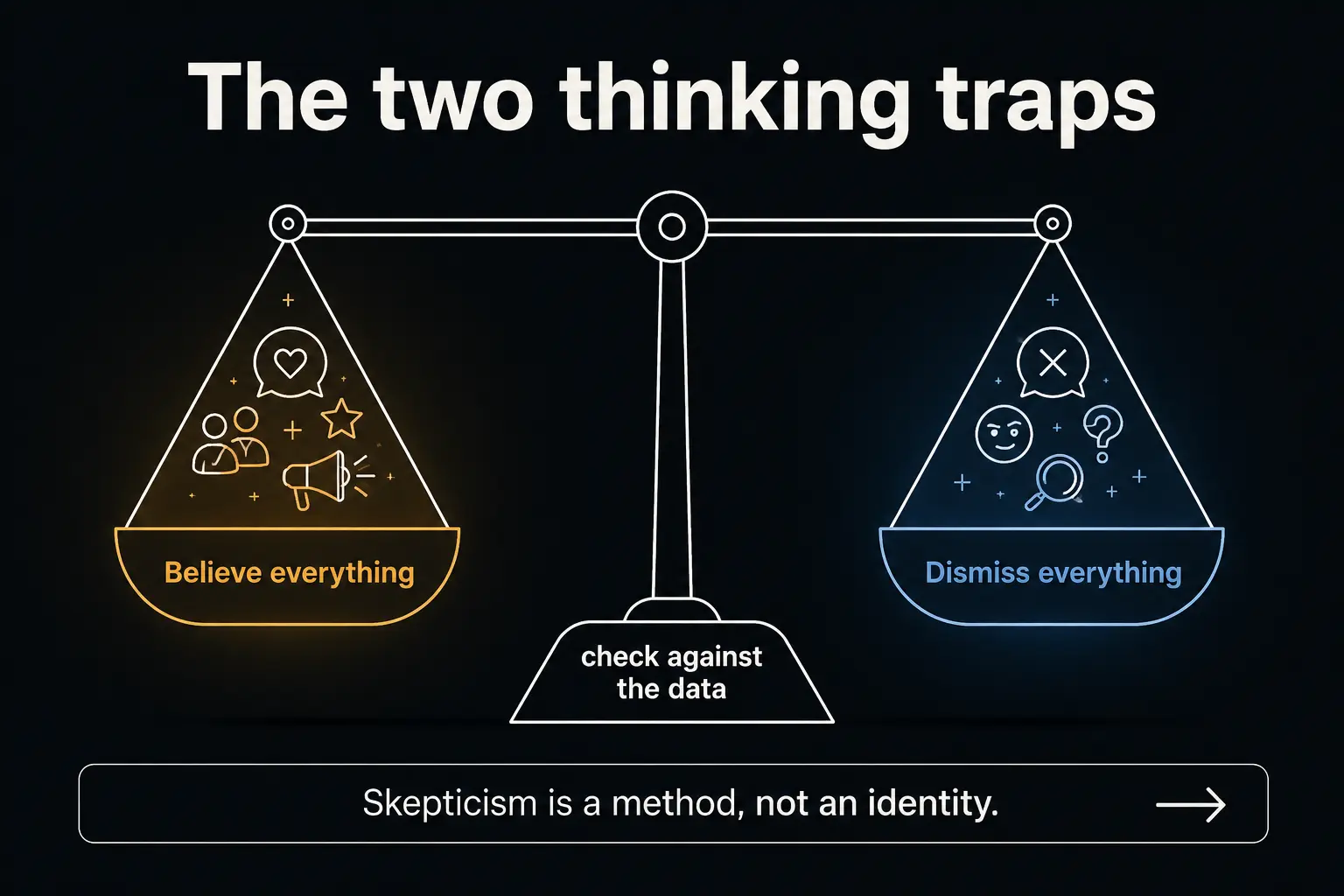
Between “believe everything” and “dismiss everything” lies not a third camp but a method. That is exactly where serious inquiry aims.
The two extremes are comfortable: they deliver quick certainty. The healthy place, however, is not the lazy compromise in the middle but a change of question — from “who is right?” to “what has been checked?”.
The healthy place is not the middle as a compromise — but the method: check, rather than believe or dismiss.
Graphic illustration · KI-generiert (GPT-Image-2, From Beyond Space), faktengeprüft
Thinking trap
The believer’s error
Whoever is already convinced takes every confirmation seriously and skips the check. “Credible” gets confused with “proven.”
The error is not naivety but a shortcut: whatever fits the picture is no longer questioned. Thus an honest statement becomes a fact and a gap becomes a miracle.
Credible does not mean proven
A statement under oath makes a claim worth checking — not proven. Taking it seriously and adopting it are two different things.
A senior, honest witness raises the weight of a claim but does not replace data. The believer’s error skips this difference — more on separating documented from claimed in What counts as evidence?.
Thinking trap
The debunker’s error
Whoever has already waved it off explains too quickly and calls it skepticism. “Plausible” gets confused with “proven” — just the other way around.
Real skepticism also tests one’s own favourite explanation. The debunker’s error skips exactly that: the most obvious reading is declared a fact without measuring it against the data.
No evidence is not counter-evidence
“Nothing was found” does not mean “it was refuted.” Missing evidence leaves a question open — it does not close it.
The debunker’s error turns a gap into a verdict: because no proof exists, the matter is treated as settled. But absence of evidence is only a weak hint after a careful, sufficient search — never proof of absence.
Context
The same pattern, just mirrored
Both leap to the answer that fits their expectation — and stop checking right there. The direction differs, the error is the same.
On the same case the mirror image appears: one sees the confirmation, the other the refutation — both without the sober cross-check that Ordinary explanations for UFOs demonstrates.
“A credible pilot reports it — so it was real and extraordinary.”
“Pilots can be fooled — so it was surely nothing and the report worthless.”

KI-generiert (Seedream 4.5, From Beyond Space), Illustration
Confirmation bias — the shared root
We all preferentially seek what supports our expectation. This very reflex drives both thinking traps.
Confirmation bias is no sign of stupidity but a built-in shortcut of the brain. That is why “trying harder” doesn’t help — only a habit does: actively look for what would refute your own reading.
Claim
The shared cure: check against the data
The same thing helps against both traps: don’t ask “who is right?” but “what do source, data and context show — and what would change my mind?”.
The cure is uncomfortable because it tests one’s own favourite reading as hard as the other’s — and tolerates uncertainty. It is the same as in What counts as evidence?: measure by the matter, not by the camp.
The change-my-mind test
Name in advance what would change your mind. Whoever has no answer is believing or debunking — not checking.
A simple, honest test: “Which concrete finding would flip my position?” If nothing comes to mind, the position is not a conclusion but a commitment — equally so on both sides.
Open question
Skepticism is a method, not an identity
You don’t have to join a camp. The stronger stance is to keep the question open and the checking honest.
The honest answer to the guiding question: both sides err when they turn a stance into an identity. Whoever checks rather than believes or dismisses stays curious without being credulous — and serious without becoming a know-it-all.