Topic · Government, files & the public · 2026-07-23
What does a secret document prove?
A “top secret” stamp, a redacted page, a leaked memo — it instantly feels like proof. Usually it is the start of the check, not its end.
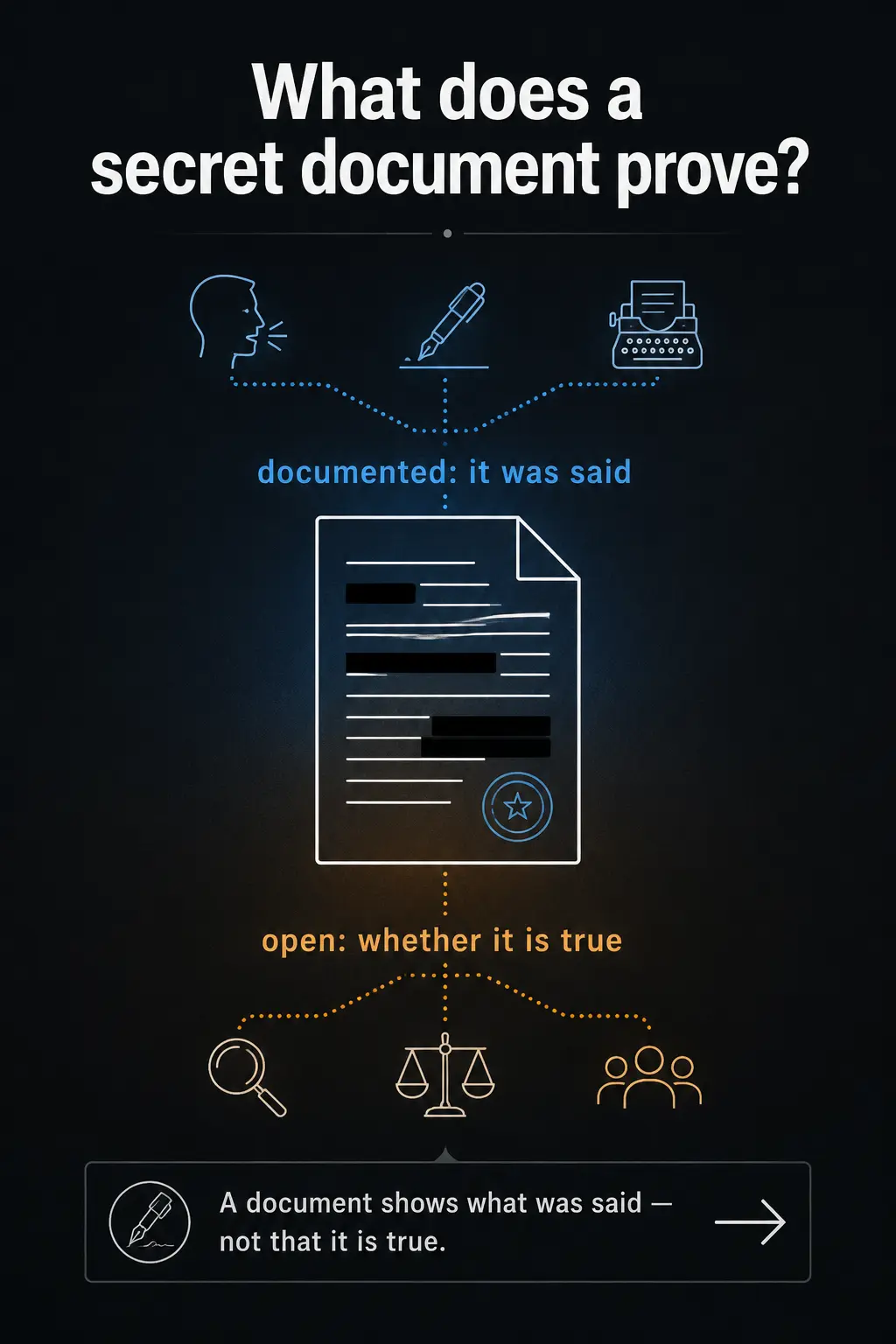
Declassified files, redacted pages, secret memos — which of these is really proof, and of what?
A document proves that something was written, reported or investigated — not that its content is true. Authenticity and truth are two different questions.
This spine shows what files actually prove, how they reach the public via FOIA, why redactions are usually routine — and why “genuine” does not mean “true.” It is the documents companion to What counts as evidence?.
KI-generiert (Seedream 4.5, From Beyond Space), Illustration
Context
What a document actually proves
A genuine document reliably proves only one thing: that someone wrote this at a point in time. Whether the content is true is the next question.
Between “the document exists” and “the content is true” lie several steps. Keeping them apart lets you read any file more calmly — and fall less often for spectacular claims just because they sit on official letterhead.
A memo reports — it does not attest
If a document records a rumour or a report, it proves it was talked about — not that it is correct.
Many “revelations” are official paper passing on a claim. That is valuable for the question “what did the agency know/believe?” — but no proof of the claim’s truth itself.
Graphic illustration · KI-generiert (GPT-Image-2, From Beyond Space), faktengeprüft
Context
How files become public — FOIA & declassification
Most “secret” documents are not leaked but released through regular channels — via requests, deadlines and reviews.
In the US the Freedom of Information Act (FOIA) compels agencies to release files on request; automatic declassification deadlines add to this. Before release, files are reviewed and redacted. That explains why so much material exists — and why it is almost always processed.
Thinking trap
Redacted does not mean covered up
Black bars feel like a confession. Usually they hide routine — names, sources, methods — not the sensational.
Redactions follow fixed rules: personal data, ongoing operations, intelligence sources. Reading “the hidden truth” into a redacted paragraph is the same leap as in Believing too fast, dismissing too fast — you fill the gap with your own expectation.
The vast majority of redactions are routine — not proof of a secret.
KI-generiert (Seedream 4.5, From Beyond Space), Illustration
What gets redacted — and why
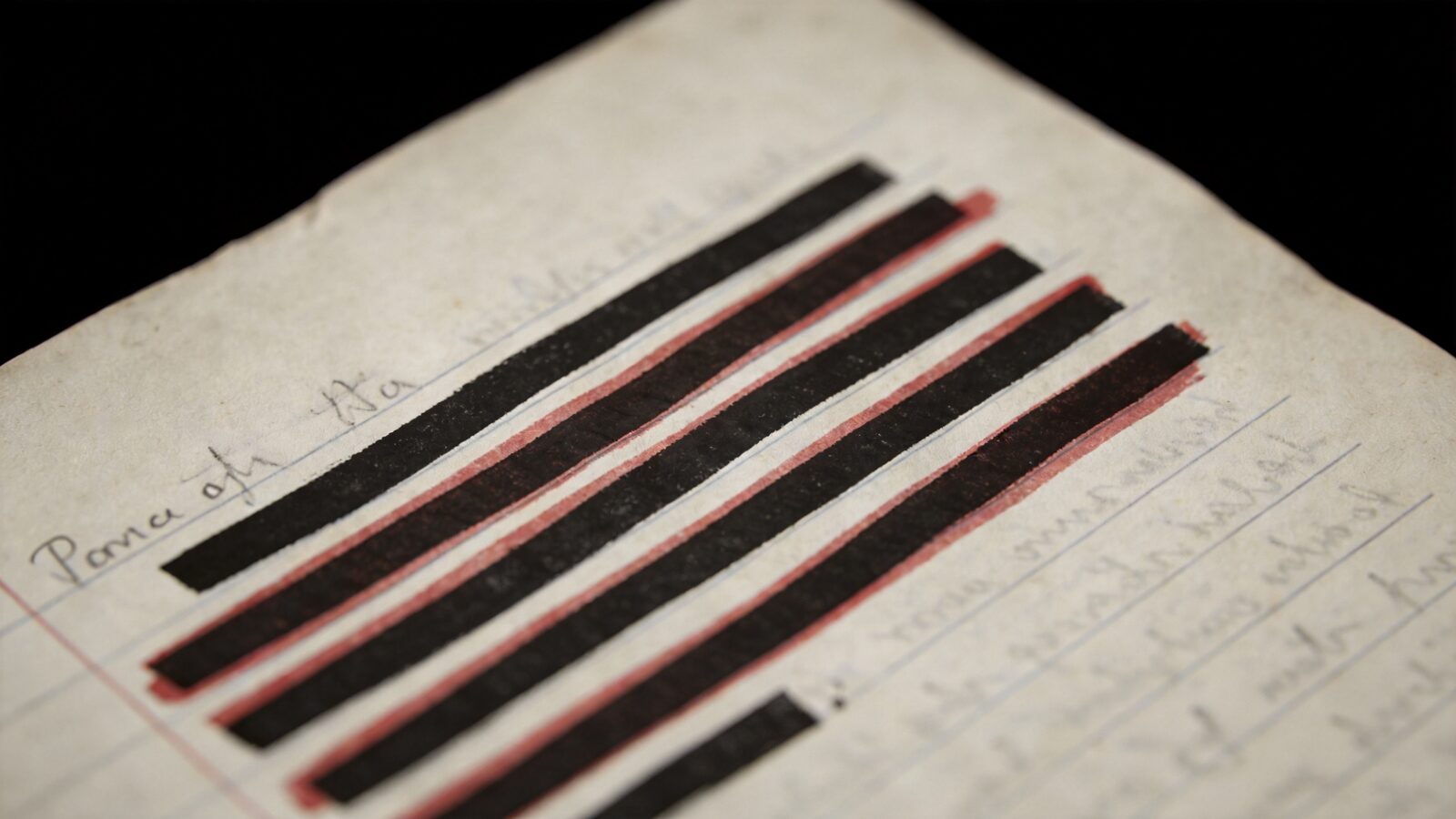
Personal names, intelligence sources and methods, ongoing operations: most redactions protect people and procedures.
So a redacted paragraph usually points to details worth protecting, not to a hidden marvel. Sometimes too much is redacted — that is a transparency problem, but no proof of extraordinary content.
Thinking trap
Genuine is not the same as true
A document can be unquestionably genuine and still contain a false claim — because its author was mistaken or noted a rumour.
A genuine memo recording a rumour documents the rumour — not its content. That is exactly why “the document is authenticated” never suffices as a conclusion; it is the same difference as “statement under oath” vs. proven.
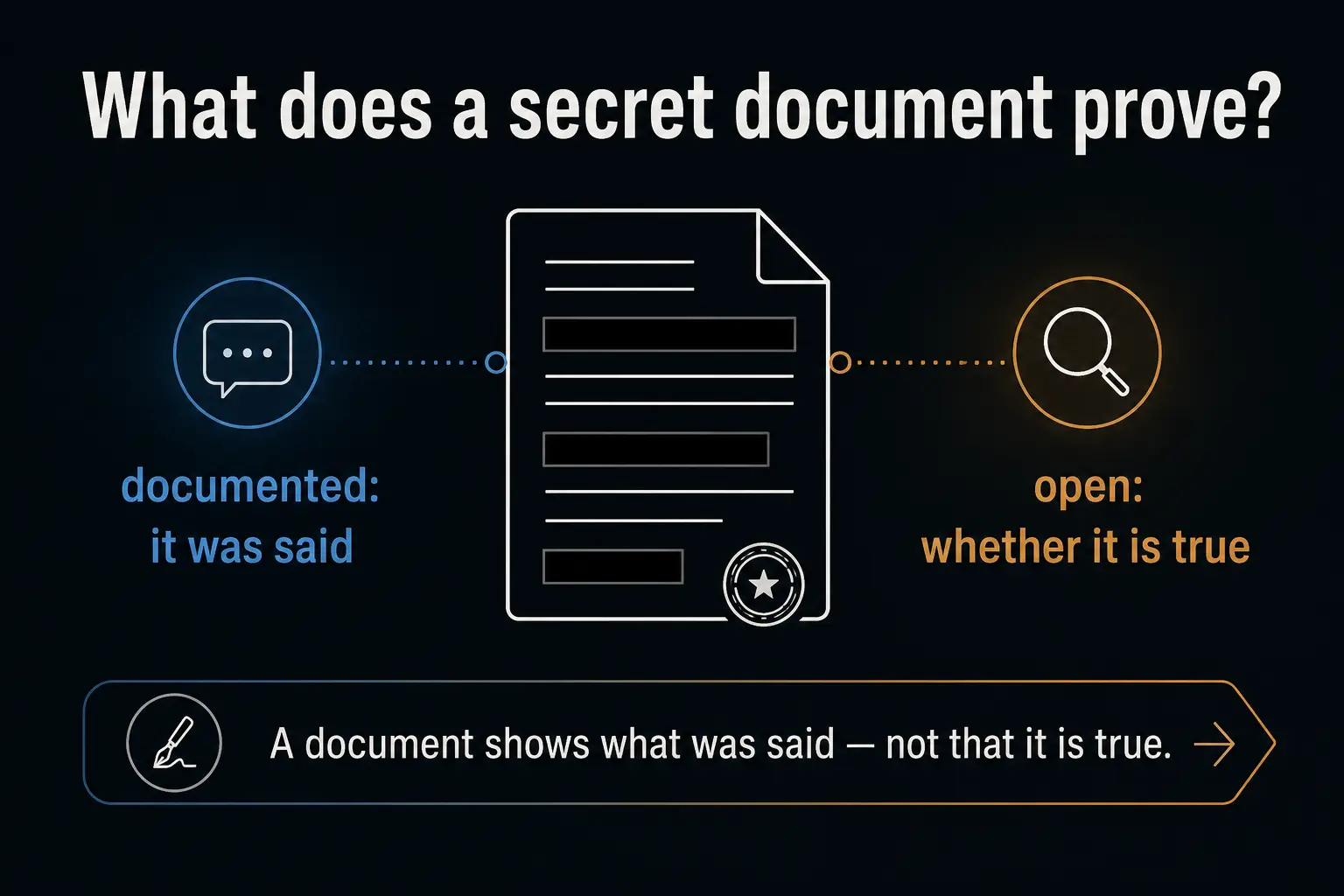
The document is genuine: origin, date and author are traceable.
Whether the content is true is open — that needs independent evidence.
MJ-12: the textbook forgery
The most famous “secret UFO documents” surfaced anonymously in 1984 — and are today widely considered a forgery.
The MJ-12 papers supposedly describe a secret government group on the Roswell case. The FBI classified them as “completely bogus”; skeptics found inconsistencies (dating style, a 1963 typeface). The lesson: a document that looks genuine proves nothing — provenance and checking decide.
Claim
How to read a document
Four questions turn a piece of paper into assessable evidence: Who? With what mandate? On what data basis? And: what does it not say?
This check is the same as for official reports in Who studies UAP worldwide?. It guards against both errors: overrating the document and dismissing it too quickly.
Open question
So: proof or just paper?
A document is a beginning, not a verdict. It shows what was said — not that it is true. The rest is checking.
The honest answer to the guiding question: files are valuable because they record what agencies really did and thought — but their mere existence proves no extraordinary claim. Keeping that apart lets you read any “secret file” headline with confidence.