Topic · Thinking tools & scepticism · 2026-07-27
Who says so — and how do they know?
A witness with rank, uniform and security clearance sounds like evidence. But the decisive question is a different one: how close were they really?
What makes a witness statement hold up — and why does their rank say almost nothing about it?
The value of a statement is decided by proximity to the event, verifiability and interests — not by rank, demeanour or how often it has been repeated.
This spine deals with only one kind of source: the human being. How to check documents is covered in What does a secret document prove?; what a whole case rests on, in What counts as evidence?. Here it is about four things: proximity, timing, verifiability and interest.
KI-generiert (Seedream 4.5, From Beyond Space), Illustration
Context
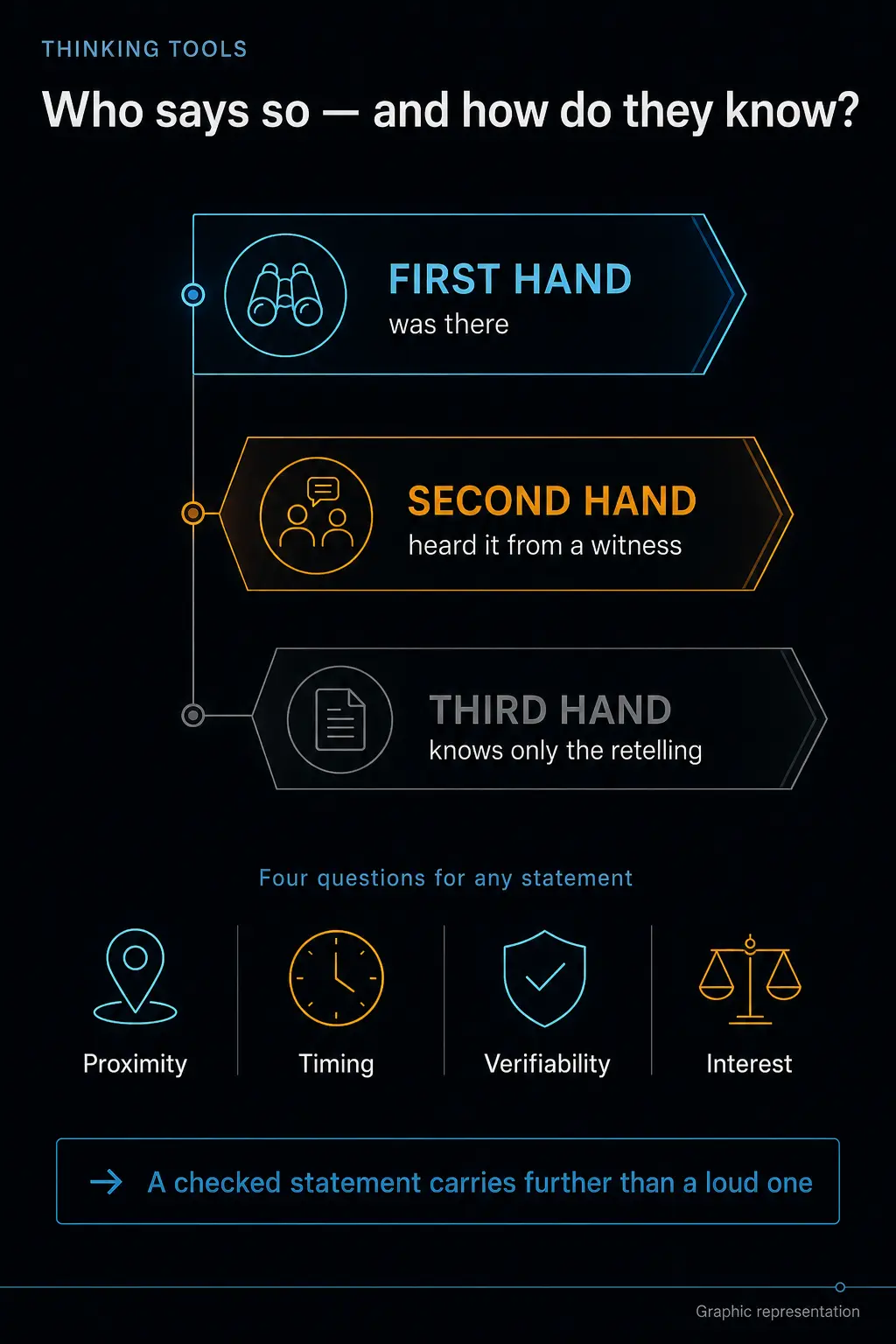
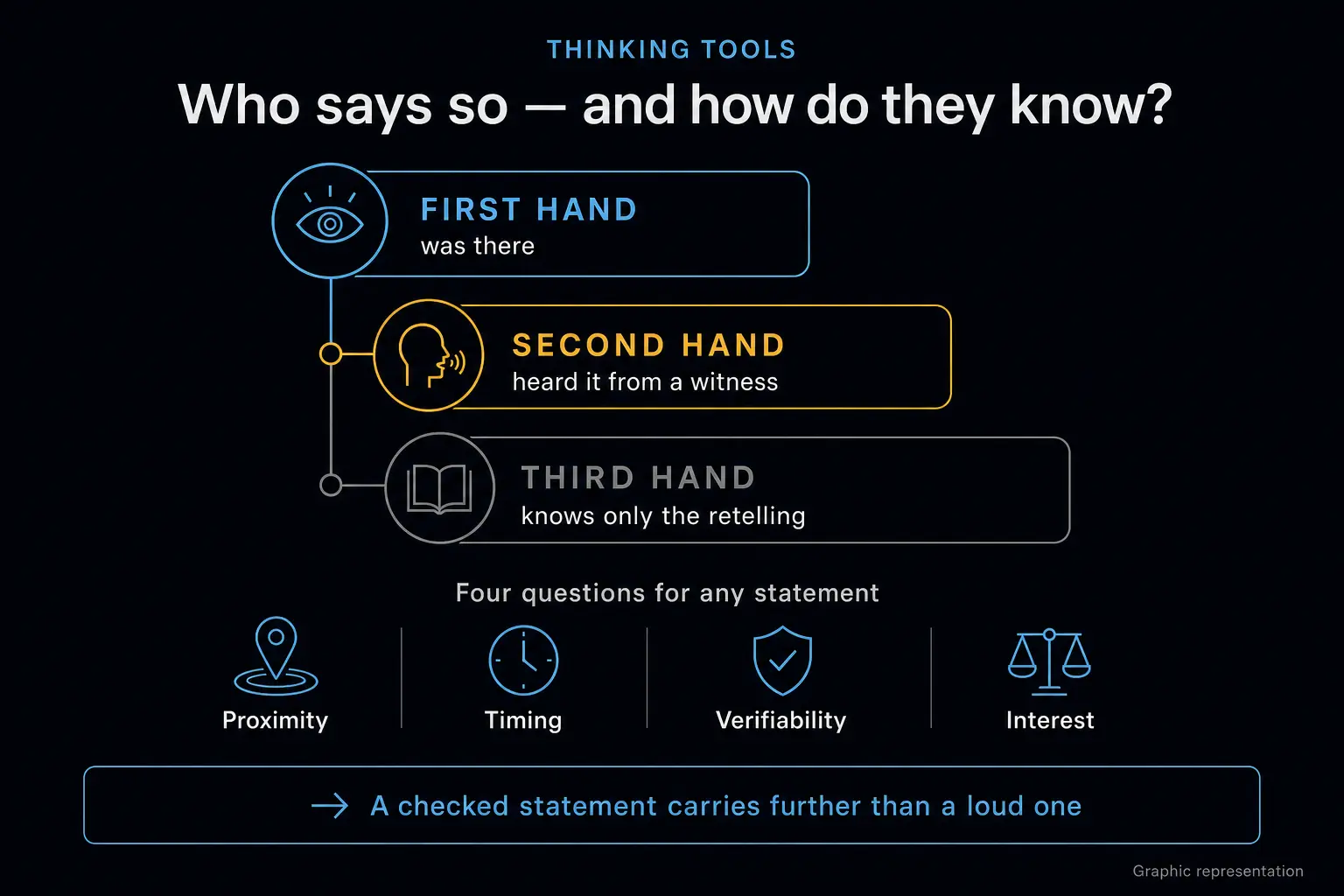
First, second, third hand
Every retelling costs precision. Someone who was there is making a different kind of statement than someone who heard about it.
This is not a question of honesty. Even a completely sincere chain loses details with every link — and gains new ones that nobody invented but that emerge in the retelling. That is why the first question to any statement is not “is it true?” but “how many hands lie in between?”.
Where the new details come from
In a chain of retellings, details emerge that nobody invented: gaps get filled with the plausible, guesses turn into specifics.
Anyone retelling smooths things out unconsciously: the unclear is made comprehensible, hesitation disappears, a “maybe three metres” becomes “three metres”. The result is a well-rounded story — and its very roundness is a warning sign, because real observations are rarely smooth.
Graphic illustration · KI-generiert (GPT-Image-2, From Beyond Space), faktengeprüft
Thinking trap
Rank is not proximity
A general who knows something by hearsay is a weaker source for that event than the technician who stood in front of it.
Rank, clearance and years of service answer a different question: whether someone had access to a field. They do not answer whether they were present at this particular event. This is exactly where debates slip most often — the authority of the person is turned into the authority of the statement.
Access to a domain, knowledge of procedures, professional risk when making a false statement. That is not nothing.
That the person was present at the event they are describing — or that their informants were.
The anonymous insider
If a source stays anonymous, their position cannot be checked — and that removes exactly the part that was supposed to carry the statement.
Anonymity can have good reasons: secrecy obligations, professional consequences, ongoing proceedings. So it is no proof of dishonesty. But it comes at a price, and the statement pays it: without a checkable position it remains a claim with nothing to anchor it. How far this can go is shown by the case of the anonymously surfaced “MJ-12” papers.
Self-interest is not a verdict
A book, a documentary, a career: profiting from a statement does not make someone a liar. But the statement deserves more care.
The fallacy runs in both directions: “he profits from it, so he is lying” is just as sloppy as “he is risking something, so it is true”. Interest is not a truth value but a reason to look more closely — for critics, incidentally, just as much as for witnesses.
Thinking trap
Twenty reports, one source
A claim that appears everywhere feels confirmed. Often it is merely often quoted — and traces back to a single origin.
Repetition is not confirmation. Confirmation would be a second, independent source that observed the same thing independently. The test for this is uncomfortable but simple: follow every report back to its origin. If they all end at the same person, you have read one source — twenty times.
How to spot a cascade
All reports appeared in quick succession, none cites its own research, and the wording is conspicuously similar.
Three moves usually suffice: look at the dates of the reports, search the text for the word “according to”, and check what it points at. If every trail leads to the same origin, the number of hits is no longer an argument — it is just an echo.
Turning point
confirmedHow a motion became a shape
In 1947 Kenneth Arnold described how the objects flew — like a saucer skipping across water. The press turned that into how they looked.
Arnold compared the flight motion, not the shape; headline writers coined “flying saucer” from it (Wikipedia: Flying saucer). The error was not without consequence: the saucer shape became the image readers carried in their heads — and appeared in reports afterwards. A single imprecise retelling shaped the expectations of an entire field.
Claim
Four questions for any statement
Proximity, timing, verifiability, interest: whoever asks these four questions needs no verdict about the person.
The advantage of these four questions is that they work without insinuation. They do not ask whether someone is lying — but what their statement can carry. This lets you take a source seriously and still place it; that is exactly what separates checking from believing or dismissing.
Memory ages
Most Roswell testimonies were collected from 1978 onwards — more than three decades after 1947, in a completely changed climate of expectation.
Intelligence officer Jesse Marcel spoke in 1947 of foil and broken wooden beams; in 1978 he called the weather balloon explanation a cover story (Wikipedia: Roswell incident). This need not be dishonesty: memory is rewritten over decades — by what one has since read, seen and told oneself. That is why the timing of a statement counts almost as much as its content.
Open question
Taking seriously means asking
The most respectful response to a witness statement is not to believe it or to smirk at it — but to ask where the knowledge comes from.
Asking about origin insinuates nothing. It treats the statement as what it is: the beginning of an inquiry. And you quickly notice that the more interesting question is rarely “is he lying?” but “what exactly can this person actually know?”.