Topic · Research & institutions · 2026-07-23
Who studies UFOs — without governments?
UAP research is by no means only a matter for the Pentagon and NASA. A whole civilian, scientific world is measuring too — and some of it works remarkably rigorously.
If not only governments — who else studies UAP, and what makes their work serious rather than speculative?
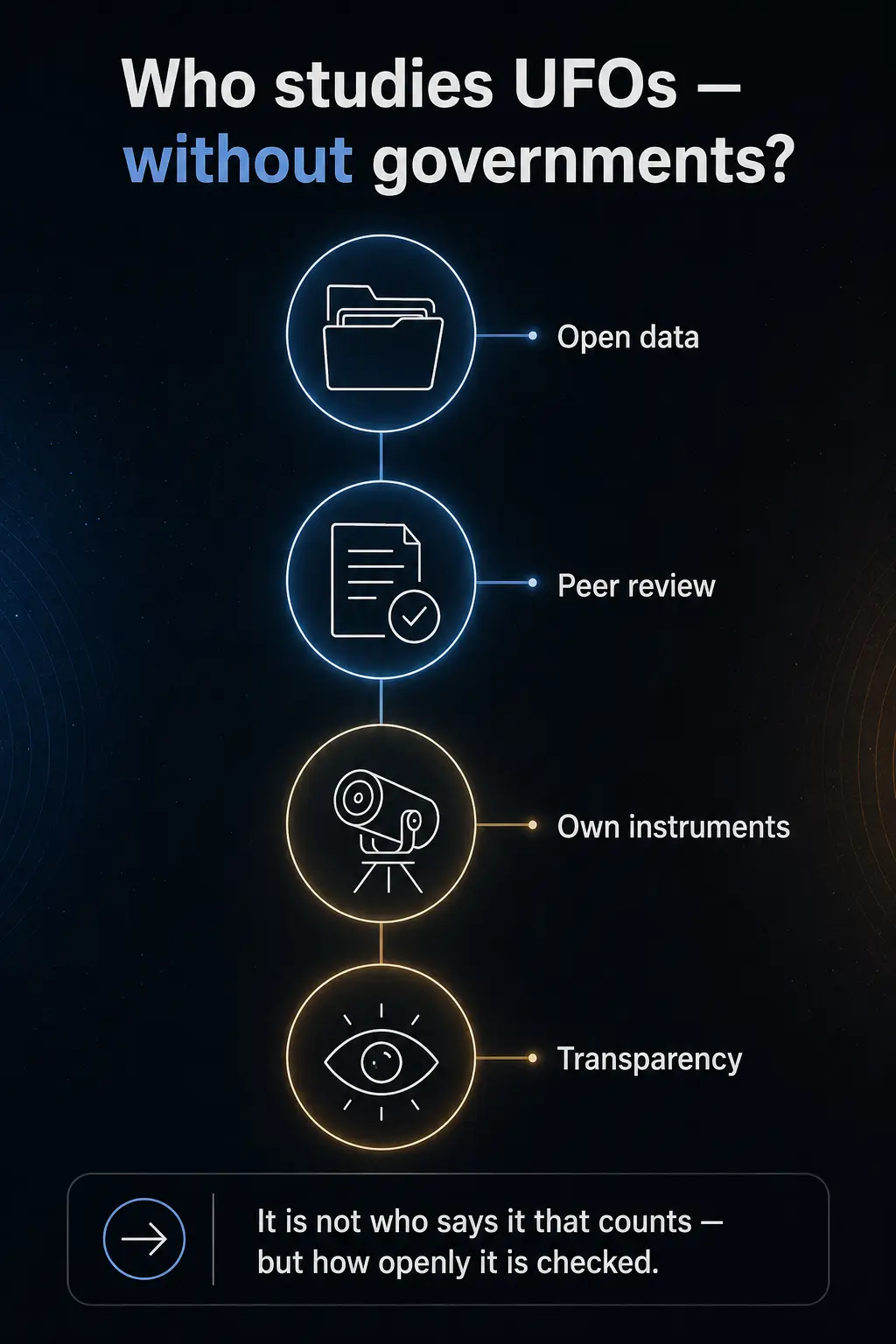
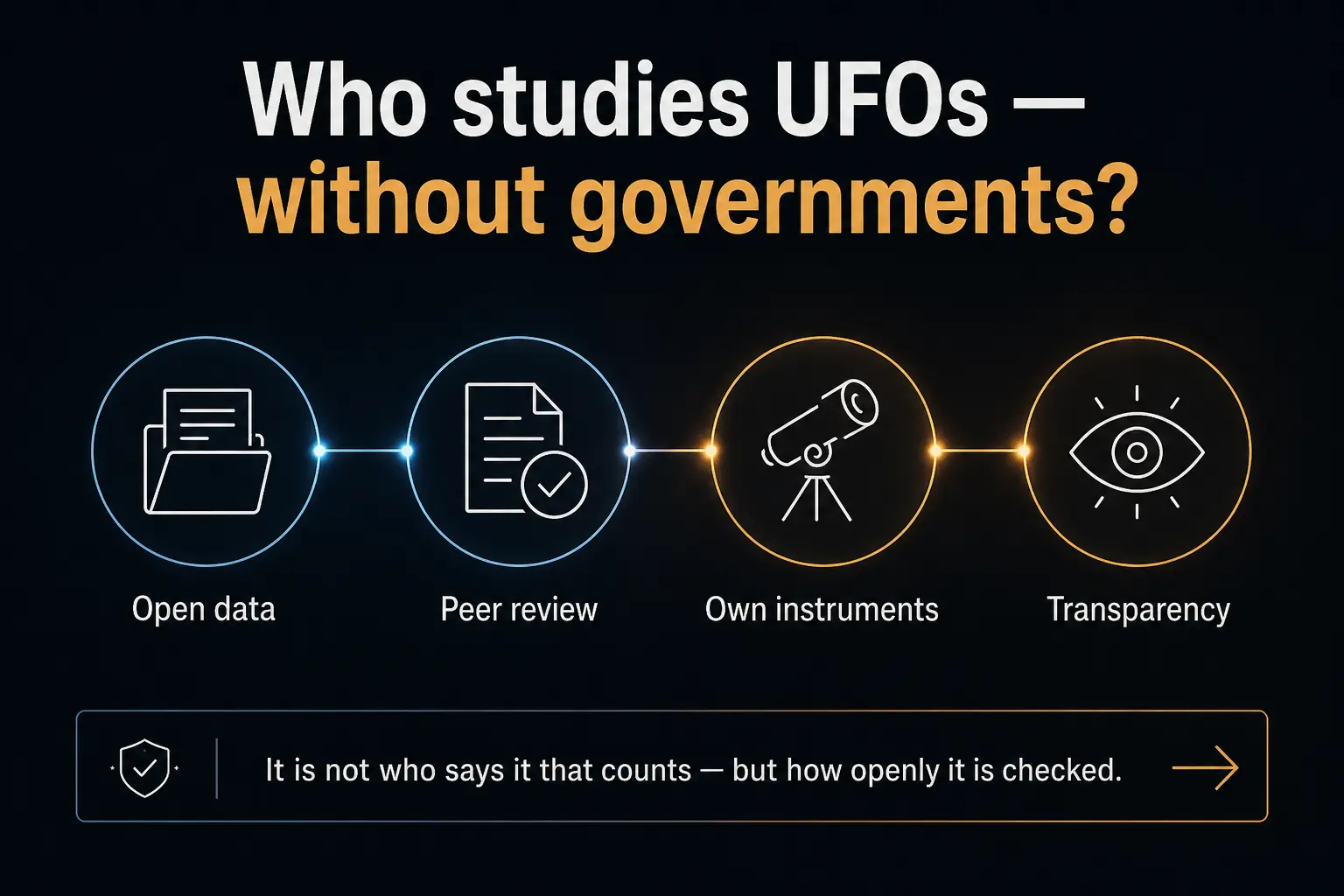
Seriousness is recognised not by the name but by the method: open data, peer review, own instruments, transparency. Even rigorous civilian research has so far proven nothing extraordinary — it measures honestly.
This spine shows how to recognise serious UAP research, who is out there measuring — and why “non-governmental” does not mean “unscientific.” The state side is covered in Who studies UAP worldwide?.
KI-generiert (Seedream 4.5, From Beyond Space), Illustration
Context
How to recognise serious research
It is not the name that makes research serious but four features — by which real science differs from collecting enthusiasm.
These features are the yardstick for the whole topic. They are the same language as in What counts as evidence? — just applied to organisations instead of single cases.
Graphic illustration · KI-generiert (GPT-Image-2, From Beyond Space), faktengeprüft
Context
The civilian research world
From the pioneers of the 1970s to today’s Harvard projects: civilian UAP research has grown over decades and become more professional.
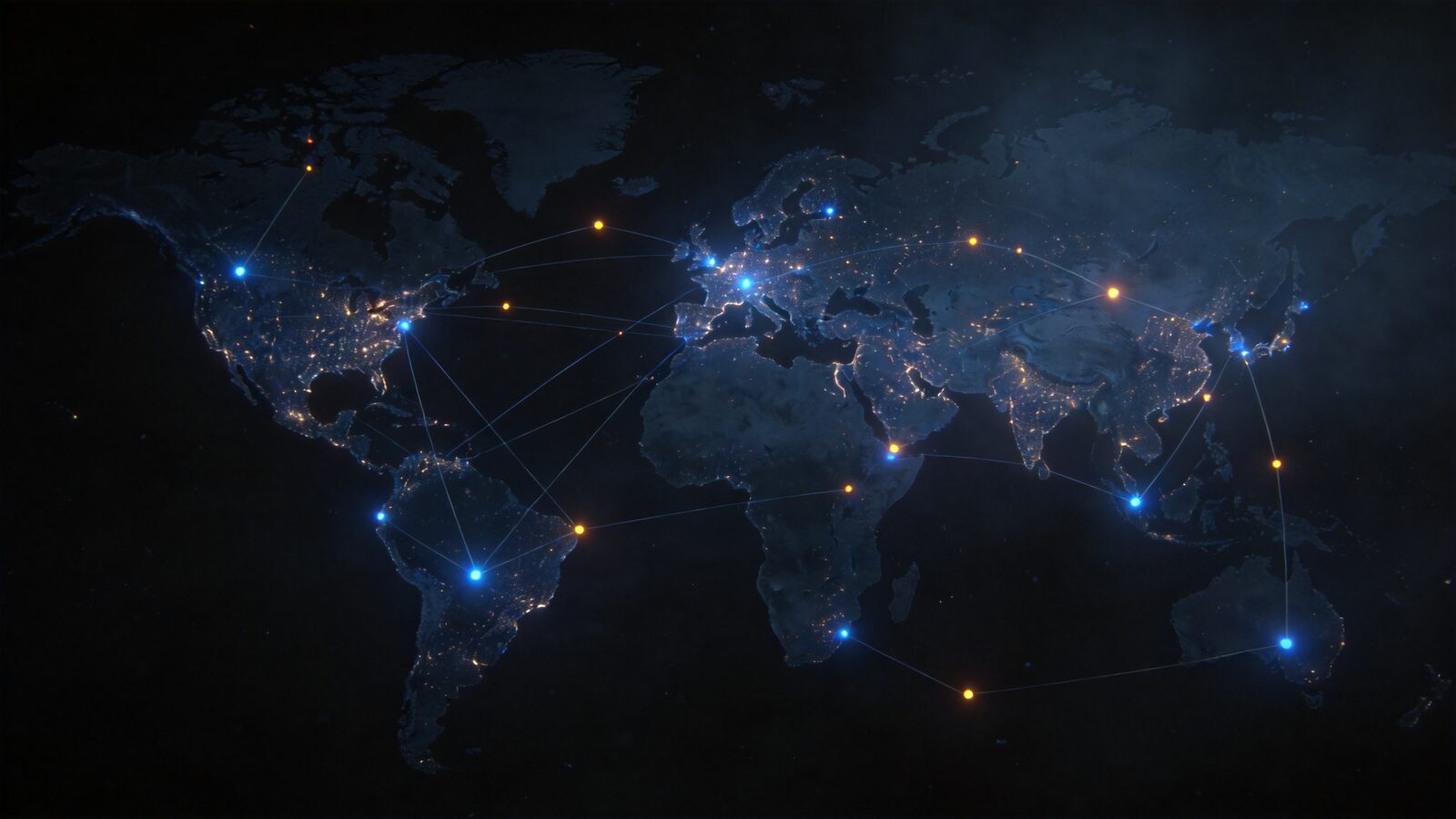
The side-arms introduce the most important organisations — each linked to its profile. They range from large reporting networks to instrument-based science; this is exactly where “serious” can turn out very differently.
- 1969
MUFON
largest reporting network founded
- 1973
CUFOS
Hynek’s scientific center
- 1999
NARCAP
aviation safety & pilot reports
- 2017
SCU
peer-reviewed analyses
- 2021
Galileo · UAPx · ICER
own sensors, global coalition
- 2023
Sol Foundation
academic think tank
KI-generiert (Seedream 4.5, From Beyond Space), Illustration
Galileo Project — science with its own sensors
The most prominent example of instrument-based, open UAP research: own sensor networks, unclassified data, published methodology.
The Galileo Project was founded in 2021 by Harvard astrophysicist Avi Loeb. It works exclusively with open, unclassified data from its own multi-sensor stations and publishes results peer-reviewed — the textbook case for the four features.
SCU & UAPx — peer review and field measurements
Two scientific groups tackling UAP with physics: rigorous analyses and own sensor expeditions, published in peer-reviewed journals.
The SCU (Scientific Coalition for UAP Studies, 2017) brings together scientists and engineers for peer-reviewed case analyses. UAPx (2021, around physicists Kevin Knuth and Matthew Szydagis) measures in the field with calibrated sensors and published in a peer-reviewed journal in 2025.
Sol Foundation — thinking through the implications
Not a sensor project but an academic think tank: what would it mean politically, legally and socially if something were confirmed?
The Sol Foundation (2023, around Stanford immunologist Garry Nolan) works on policy and governance questions around UAP. What is serious here is not the instrumentation but the sober, academic approach to a speculative subject.
GEP & European reporting centres
Volunteer, sober case work: reporting centres take in sightings, resolve the bulk conventionally and document the rest.
The German GEP (Society for the Study of the UFO Phenomenon, since 1972) resolves roughly nine out of ten reports conventionally — exactly the work shown in Ordinary explanations for UFOs. What makes it serious is the consistent ruling-out analysis.
The pioneers: CUFOS & NARCAP
Two classics that focused on method early: astronomer Hynek and NASA scientist Haines — the latter even coined the term “UAP.”
The CUFOS (Center for UFO Studies, 1973) was founded by astronomer J. Allen Hynek as a scientific alternative to the military. The NARCAP (1999, Dr. Richard F. Haines) focuses on aviation safety and pilot reports — and coined the de-stigmatised term “UAP” in 2000.
Large networks: MUFON & ICER — with a measured eye
Reach is not the same as rigour. Large networks collect enormous amounts — but the quality of individual work varies widely.
The MUFON (Mutual UFO Network, 1969) is the largest civilian reporting network, but works on a volunteer basis and unevenly — sometimes careful, sometimes not. The coalition ICER (2021) connects researchers from 27 countries, but is more coordination and awareness work than instrument-based science. Both belong here — but measured against the four features.
Thinking trap
Serious does not mean: is right
Even the most rigorous civilian research has so far proven nothing extraordinary. Seriousness is a question of method, not of result.
“A real scientist says so” is itself a thinking trap — the same one as in Believing too fast, dismissing too fast. Good research is recognised by testing its own results hard and leaving uncertainty open.
Context
What civilian research can do — and where its limits are
Civilian research is open and independent — but it has less money and no access to secret military sensors. Both belong to an honest balance.
That is exactly why the civilian and state sides complement each other: one is open and checkable, the other has sensors and data no one else can reach.
Open, unclassified data, public method, independent of agencies — anyone can check.
Less money, no access to military radar/sensor data, limited reach of their own instruments.
Context
Why this matters at all
Open, independent science is the only authority that anyone can check for themselves — regardless of whom one currently trusts.
It shifts the topic from “believe or not” to “measure and check.” Civilian research is thus no replacement for state investigation but its most important independent check.
Open question
So whom to believe? No one — check.
The stronger question is not “who says it?” but “how open and checkable is it?”. That is exactly how to measure any organisation.
The honest answer to the guiding question: serious civilian UAP research exists — recognisable not by the name but by open data, peer review and honest uncertainty. With that in mind, you can place any headline about “new UFO evidence” yourself.